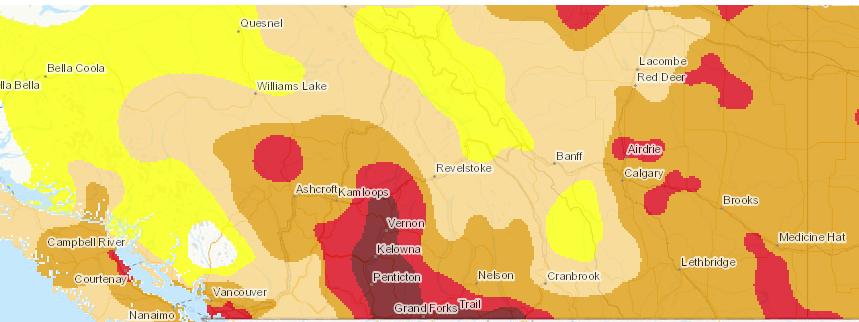
Pacific Region (BC)
Precipitation across British Columbia for the month of August remained slightly below normal,
except the southeast corner near Cranbrook, which saw substantial precipitation. Despite more
precipitation in the last 30 days, overall precipitation for the growing season remained
extremely low across the Interior, as well as the Lower Mainland and onto Vancouver Island.
Streamflow also remained well below normal, if not record low, as of the end of the month.
Minimal changes were made to drought extent and severity in the province, though both
Extreme (D3) and Exceptional Drought (D4) were increased in the province’s Interior region.
Water restrictions were put in place in the Thompson-Okanagan region in order to reduce the
strain on aquatic life and restore the flow volumes required to ensure the survival of significant
aquatic species. Concern also remains for cattle as ranchers face hay shortages due to the
drought and unseasonably hot weather throughout the summer. Moderate Drought (D1) was
also expanded to include all of Vancouver Island, given a nearly 275 mm deficit since the
growing season began on April 1st. Although temperatures in August were not significantly
above normal, at least 6 towns/cities reported their warmest June-July-August period on
record.
Contrary to the concerns in the Interior, Lower Mainland and Island, the southeastern corner of
the province received significant rainfall in August. The city of Cranbrook reported their wettest
August on record with a whopping 350 percent of normal precipitation. This significant increase
in moisture led to the removal of Extreme Drought (D3) and a reduction of Severe Drought (D2)
in the area.
By the end of August, sixty-six percent of the Pacific region was categorized as Abnormally Dry
(D0) and nearly forty percent of the region was in Moderate to Exceptional Drought (D1-D4);
these conditions accounted for ninety-one percent of the region’s agricultural landscape.
Source: Ag Canada