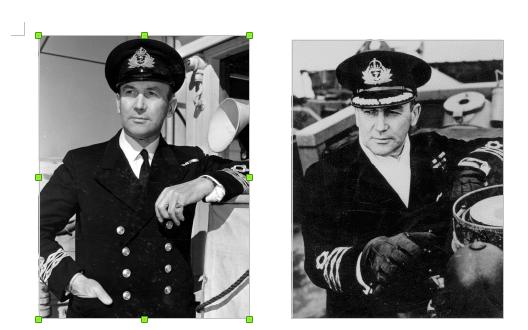
Remembering Clarence King DSO DSC Legion of Merit (US) 1886-1964
In August 1942, while escorting a 29 ship Convoy TAW-15 in the Caribbean, a lone Canadian Corvette, HMCS Oakville, gained international recognition when it attacked and sunk U-94. The U-boat had been spotted by a US navy plane which released four depth bombs and a flare. Oakville rushed into action and dropped 5 depth charges without asdic contact. The U-boat was forced to the surface and a duel in the dark ensued, with Oakville ramming the U-boat three times, smashing it with 4 inch shells, raking it with machine gun fire. [1]
The Commanding Officer, a DSC winner in the Great War, “no man for half-measures”, attempted final ramming and was successful. Then, bringing the Oakville alongside the submarine, a two-man boarding party consisting of Sub-Lieutenant Hal Lawrence of Halifax and Stoker Petty Officer Art Powell of London, Ontario leapt aboard. While Powell contained the scuttling submariners, Lawrence scrambled below to seize confidential signals books. This proved fruitless, as the U-boat was sinking and the two Canadians and 26 surviving Germans abandoned the boat. This battle lasted 45 minutes. After the ’survivors were secured, the Oakville limped, unassisted to the US Naval Base at Guantanamo Bay.
All submarine kills were valuable, and this one in particular was satisfying as U-94, a Type X C, had sunk 28 ships since putting to sea in December 1940.[2] Described in Lawrence’s A Bloody War, the sinking of U-94 was one of the more swashbuckling adventures in RCN history. It must have been particularly satisfying to Oakville‘s Commanding Officer, a fruit grower from the South Okanagan Valley, the oldest sea-going officer in the Canadian Navy during World War Two, Clarence A. B. C. King.[3]
“The spirit and dash of HMCS Oakville was worthy of the highest tradition of any service.”[4] For their spirit, the Oakville’s crew was presented ten awards; a DSO for Commanding Officer; a DSC for Lawrence, DSM, for Powell and David Wilson, the stoker petty officer on watch when the boiler room flooded, as well as six ‘Mentioned in Dispatches‘.
Born in 1886 in Islington, on the outskirts of London, England, Clarence King first went to sea as a 13 year old cadet on board a Merchant Marine School ship and by the time he was 25, he held a Masters’ Ticket. Clarence King came to Canada by way of Juno, Alaska where he had been the Harbour Master. He left Alaska as he wanted to live under the Union Jack. He farmed near Kamloops, B.C. then Marquette, Manitoba before the Great War.
Because of his Merchant Marine Service, King was granted a temporary commission in the Royal Naval Reserve in 1916. After some basic courses, King joined Motor Launch 65 on Anti-submarine patrols in the English Channel. In April, he was transferred to the Special Service Ship Q 28 SSV Merops. These vessels, disguised as merchant ships of all types, fitted with hidden armament, were designed to attract and then attack U-boats. Temporary Lt. King served first as navigator in a two-masted brigantine, with hidden 3-inch and 4-inch guns on deck in an arm of the RN made up of experienced Merchant Marine personnel. On Merops, he earned his first DSC for a spirited action with a U-boat in May 1917. By November ’17, King was commanding an armed trawler, a Q Boat that dueled a U-Boat to death in April 1918 (one of fourteen by Q‘s) and probably destroyed two more. [5]
After the Great War, Clarence King returned to Marquette, Manitoba. In 1927, he and his growing family moved to a soldier’s settlement, south-west of Dead-Man’s Lake south of Oliver, British Columbia.
Shortly before the start of the Second World War, having read the international situation clearly, this Great War Veteran again offered the Royal Navy his services. In September, 1939, King was ordered to and served on shore in Panama as a shipping advisor for Naval Control of Merchant Shipping. In 1941, now an acting Lt Comdr. RNR., King was appointed to command an anti-submarine patrol in Bermuda. In spite of his 55 years, he wanted to serve at sea. This desire was achieved in January 1942, when King transferred to the RCNR, commanding briefly, the corvettes Saskatoon and Nipigon. In May 1942, he assumed command of HMCS Oakville.
“Captain King was aboard a short time when we heard the pipe, ‘Man overboard’. And everyone ran to the side to see who the silly bugger was who had fallen over. It had been a drill and, of course, we got hell from the captain for being stupid. The next drill was ‘fire in the galley’, but we were ready…There was an informality about corvette life that particularly suited the RCNVR ratings. Oakville was not a pusser ship; by that I mean there was not much navy routine. For instance, when entering or leaving, all Captain King demanded was that we wear our navy caps whereas in some ships, the crew would have to be in full uniform. After all, we were just a band of men who had joined up to fight a war and not to make a career out of it. I guess by now, you realize we loved Captain King.” Reginald Adams, Able Seaman, HMCS Oakville. [6]
In 1943, Commander Clarence King took command of a new frigate, HMCS Swansea, built in Victoria, B.C. One of his Ex-O’s felt he was inclined too often to accept miscreant’s “wildly implausible excuses” when brought before him. But then almost all of them were young enough to be his children…With Lt-Cmdr. King, “the punishment was quite often ‘cautioned’. “Don’t let me catch you at this again. Carry On,” at which the cox’n somewhat sourly would order, “Cautioned. On caps, right turn, double march!”
Coxswains liked stiff punishments which kept the boys in line and on their toes. [7]
Commander King was a consummate seaman, a good ship handler and an excellent navigator. Although certain Volunteer Reserve officers felt Cmdr. King retained a certain ‘merchant captain’s attitude’ toward not risking any unnecessary damage to ‘the owner’s property.’ Generally, his officers and crews described him with much affection and considerable respect. His crew invariably referred to him as a courteous gentleman — considerate, calm, although somewhat reserved. They felt he was very sympathetic to their needs and even peccadilloes. King tended to run his ship as an efficient merchant navy ship not as an “ideal” HMC Ship.
Referred to by some of his officers (although never to his face) as “Uncle Clarence”, King was a ‘fastidious dresser’ while his officers and crew tended to be more relaxed. But when in the face of the enemy, in Hal Lawrence’s words, King was “a fire-eater,” but when the enemy was vanquished, he became a humanitarian and did more than was required to rescue survivors. After St. Laurent, Forester and Swansea dispatched U-845, with the possibility of other U-boats in the area, King “lay stopped”, while boats rescued the survivors. For King, rescuing survivors took precedence over danger, much to the anxiety of his ships company. [8]
Further insight into Commander King’s person is noted in this conversation with Leading Seaman Sean Bately, the day after the Swansea had come under intense shelling from the coast of France in the spring of 1944.
“Frightened last night, Bately?”
“Yes sir, I was scared stiff.”
“So was I,” King responded.
It may have been true enough, although with all his experience in two wars, he was not likely subject to being very scared. His ability to relate to his crew endeared him to them.”[9]
Commanding Canadians was not easy as A.F.C. Layard records in a 2005 publication. Layard, a Royal Naval Officer, who commanded an anti-submarine support group out of Halifax and later led EG.9 in the European inshore waters, was not always impressed with the RCN. He saw many ships’ captains, especially the RCNR officers as “difficult and individualistic” (meaning ill-disciplined?). Layard observed that his senior RCNR captains were “better seaman and more experienced but not half as keen and alive” as the “fine keen bunch” of RCNVR officers. Considering the unending strain of the war at sea with which every officer and rating lived, nerves were stretched and stressed. Once the “old” sea tiger, King asked his Escort Group Commander permission to take his frigate into Ushant Harbour on the French coast and attack German merchantmen and U-boats. Layard replied, “Not Granted!”[10]
At the best of times, it is difficult to have two commanders on board the same vessel and because his ship was in dry dock, Layard shared HMCS Swansea with King for a month. At times, Layard resented King – in part at least – and especially after, King sank three U-boats, perhaps because King “could do my job better than me.”[11] When King left to command his own group, Layard wrote in his diary, “I must say, as nice as old King was, I’m damned glad he has gone, as I always felt he was slightly antagonistic to me and now it is much easier.”[12]
King was unhappy leaving HMCS Swansea; he would have preferred to command one ship not an escort group. Nevertheless, he did the job well, leaving much of the technical direction to those appointed for those tasks. [13]
Captain Clarence Aubrey Beaumont Chetwyn King, DSO, DSC, RCNR, served 52 weeks at sea. By the end the war, he was, “one of the foremost Canadian sea men of the war.”[14] He ended his service as a staff officer, Commander D at Esquimalt, returning to his family and orchard in the South Okanagan late in 1946. On his retirement, few naval officers matched his accomplishments. King’s record for sinking U-boats is almost without equal; he was one three highly successful submarine dispatchers in our Naval history. [15]
After repatriation, the King family moved to “the Anchorage’ on Osoyoos Lake, a summer house converted into a year round home. As well as his orchard, he returned to community responsibilities: the Library board, Hospital Board, School board and the Anglican Church board as well as the fruit packing business until his death in February 1964. Mrs. Olive King lived in Osoyoos until 1971 when she moved to Penticton to be near a daughter. She died in 1983. One son, Ronald, a corporal with the Seaforth Highlanders, was killed in Italy in July 1943.[16] The youngest child, Harold King, an ardent conversationalist in his early eighties, lives south of Oliver on the family property overlooking Dead Man’s Lake. (This article written before the death of Harold in 2011. He is buried with his wife Joan and both his parents in the Osoyoos Cemetery.)
Footnotes:
1. Johnson, Mac, Corvettes in Canada, McGraw-Hill, Toronto, 1994, p.270.
2. A U-boat veteran of four years, Otto Ites had sunk 100,000 tonnes of Allied shipping. In April the previous year, Hitler had decorated him with the Knight’s Cross of the Iron Class. Bold, competent, respected, Ites was popular with his crew. Arthur Bishop, Courage at Sea, McGraw-Hill Ryerson, Whitby, Ontario,1995, p.37.
3. Layard, A.F.C. Commanding Canadians, p.75
4. Johnson, p.151.
5. McKee, Fraser M., HMCS Swansea, Vanwell Publishing, St. Catherines, 1994, p.38-39.
6. Corvettes in Canada, p.152
7. HMCS Swansea, p.38-39.
8. Ibid p. 38
9. Ibid p. 72
10. Ibid p. 48
11. Commanding Canadians, p.250.
12. Legion Magazine, May/June 2006, p.88… His Escort Group: Nine operated for 15 months mainly around the English Channel between January 1944 and the end of the war in Europe. This group included well-known Canadian Naval figures — former merchant mariners, such as Alan Easton, St. Clair Balfour and Clarence King.
13. It must be noted that this is projection on Layard’s part and reveals more about his nerves than King’s character. King did not want to leave Swansea in July 1944 to become a senior officer, first in another frigate, HMCS Prince Rupert in C-3 Group and later, to HMCS Runnymede for the rest of the war as Senior Officer in C-5 Group.
14. Bishop, Arthur, Heroes as Sea, Prospero Books, Toronto, 2006, p.
15. The Oliver Times Herald, January 1946. With Lt. John Hampton Gray VC and Vice Adm. Harry G. De Wolfe CBE DSO DSC RCN, the Okanagan’s Captain Clarence King DSO DSC Legion of Merit (US) RCNR is one of the more decorated Canadian Naval Officers during World War Two. HMCS Swansea destroyed four submarines: U-845, U-448, U-311 and U-247. Canadians, for all our virtues, have little knowledge or appreciation of our history. Why? I leave you to ponder.
16. Predeceased by a daughter in 1918, a Spanish Flu victim and son, Ronald King, Corporal, killed, Sicily, 1943. Left to mourn Captain King were his wife, Oliver Hill Robinson, two sons and two daughters. His youngest son served in Korea.
Written by David Snyder of Penticton, war historian