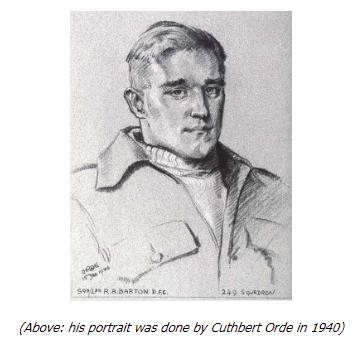
 Robert Alexander Barton OBE DFC & Bar ( 1916-2010)
7 June 2016 marked the 100 anniversary of the birth of R.A. Barton Okanagan Valley’s most decorated Air Force officer in World War Two. Born in Kamloops, his civil engineer father and Scottish mother lived in Penticton.
Schooled initially at the Vernon Prep School, young Robert traveled home at holiday time, to and from Vernon to Penticton on the SS Sicamous; he completed his education at Shawnigan Lake Boys School. [1]
In January 1936, Barton traveled to England, took a short service RAF commission and after pilot training was attached to NO. 41 Squadron equipped with biplane fighters. Following the outbreak of war he joined the newly reformed NO 249 Squadron in Yorkshire.[2] Transferred south to Boscombe-Down in August 14, 1940 Barton was in action the following day, downing one Messerschmidt and damaging another. Over the next three weeks, Barton’s successes mounted.
On September 3, flying from North Weald in Essex, his Hurricane was hit by return fire from a Dormier and Barton was forced to bale. Later upon returning to his squadron he was’ ribbed’ by his wing-mates for allowing himself to be shot down by a bomber.
Days later, during the intense phase of the Luftwatte’s onslaught, his CO was wounded and Barton led the squadron into battle, flying sometimes four missions daily. On September 15, the day of the greatest air battle, the acting S/L shot down a Dormier over the Thames Estuary and damaged a second. By the end of October Bob Barton, aka ‘Butch’ [3] had ‘chalked up’ two more enemy fighters, as well as damaging another two, landing a DFC for “outstanding leadership.”
“On the afternoon of October 29 Barton faught what was perhaps the most remarkable action of his career. The squadron was taking off from North Weald when a pack of Bf 109’s dive bombed the field. He caught up with the German ‘tail-end Charlie’ and let fly. The enemy plane began streaming glycol, but before Barton could finish off his victim the other ‘109’ throttled back and it appeared that he would be swallowed up by the German formation. One by one Barton engaged them, firing at six in all. One of them was hit and damaged, while another, taking a burst in the petrol tank, began trailing a plume of fire.The German pilot, Oberstleunant Otto Hintze, bailed out safely and was taken prisoner. Hintze was a price in himself; he was one of the Luftwaffe’s top-notch fighter-bomber pilots and had been recommeded for the Knight’s Cross.” [4]
In December, 1940 Barton was CO of the Squadron with another two enemy fighters to his credit.
In 1941 his squadron was ordered to Malta, embarking for Gibraltar on 19 May on the aircraft carrier HMS Furious then transferred to HMS ARK ROYAL as part of the fighter defenses. Barton accounted for the squadron’s first victory over the island of Malta shooting down an Italian bomber. Five days later he destroyed another bomber, this time at night. At first light, he returned to the scene to search for the Italian crew. The enemy men were found and rescued. Under Barton’s leadership 249 Squadron was one of the most successful fighter squadrons on the island of Malta.
On July 31 S/L Barton survived a plane crash. His injuries included second-degree burns. In September Bob was back with his squadron and battling Italian fighters credited with destroying one, damaging another.
“I was very conscious of the squadron’s debt to him, small and slight in stature…unassuming almost to a fault, he was a wonderful leader and one of the best fighter pilots it would be my good fortune to meet” Tom Neil, his deputy, wrote. [5] The bar of Barton’s DFC citation states: “His excellent leadership inspires the pilots under his command.”
Following a respite as chief instructor at a fighter training unit Barton took command of an airfield in the Orkneys. Later he commanded North Weald. In June 1945 W/C Barton was appointed OBE.
In August, 1945 Wing Commander R.A.Barton was posted to India and for two years to help in the creation of the Pakistan Air Force. After a number of post war fighter station postings as well the Air Ministry he retired in 1959.[5]
The Bartons returned to Canada and lived a quiet life in Hedley BC. Married for fifty years, he was predeceased by his wife of Gwen Cranswick in 1988. Butch Barton (Wing Commander, RAF retired) died on 2 September, 2010 ; his ashes were scattered on his favorite lake on 15 September, Battle of Britain Day, 2010. Barton is survived by a son who resides in Britain.
Notes
1. Situated in the Cowichan Valley on Vancouver Island, founded in 1916 modeled on independent ‘public’ schools, Shawnigan Lake School was the educational launch for two other well known ‘Old Boys’ the late Nigel Taylor CD, BCD Major retired and Rear Admiral Dick Leir CD 1920-2015.
2. Equipped with Hurricanes during the Battle of Britain. The only VC awarded to RAF Fighter Command pilot (during this battle) was won by James Brindley Nicholson while serving with 249 Sqn.. ( On August 16, F/L J.B. Nicolson was attacked and his Hurrican caught fire. Despite suffering burns, Nicolson immediately attacked another German fighter before bailing out.) One day in September, 1940 the Sqn. destroyed 20 enemy aircraft. In February, 1942, NO. 249 Sqn. converted to Spitfires in Malta. Canada’s most successful Fighter pilot in WW II, George Frederick ‘Buzz’ Beurling, DSO, DFC, DFM flew with 294 Sqn. n Malta. It is likely S/L Barton recommended “Buzz” Beurling for the DFM the decoration he most treasured.
3. Today the nickname ‘Butch’ causes raised eyebrows; a synonym for a boy ruffian, Barton called himself Bob.
4. See Hugh Halliday’s The Tumbling Sky. p.42 5. W/C Thomas F. ‘Ginger’ Neil DFC AFC AE is one of the last surviving RAF Battle of Britain Pilots -Google- 2015 interview. The 1940 Spitfire had 14.7 seconds of ammo; the 109 had 55 seconds. Which had the advantage?
6. R.A. ‘Butch’ Barton was recognized in Penticton Remembers Vol I (2008) For further reading , see, Hugh Halliday’s The Tumbling Sky , p. 37-43.