Remembering
Richard Frederick John Forty
The story of battleship BISMARK is one of the great twentieth century naval epics. Its construction completed in August 1940, BISMARK went to sea in May 1941. Nearly one hundred ships were deployed to operate with, against and because of BISMARK. Crippled by the Royal Navy and the Royal Air Force after two weeks in the North Atlantic, BISMARK was sunk on 26 May 1941.With her sinking the German surface fleet was confined to growling from ashore, not attacking at sea. BISMARK’s demise was a great morale booster at home in Britain and with the Royal Navy. [1]
Bismark’s sinking was a a naval and air affair. This account of Bismark’s sinking is compiled from the notes of the late Lt.-Cmdr Dick Forty RN, a Naval Observer, serving on HMS Norfolk, the only Royal Navy ship ‘to dog’ BISMARK for its short life in May 1941.[2]
I was a Lieutenant just finished officer’s training and was given command of two Walrus amphibian catapult aircraft from the County Class Heavy Cruiser HMS BERWICK. Having exchanged a few shells with the Heavy German Cruiser ‘Admiral Hipper’, in December 1940 BERWICK was in dry dock for repairs.
In May of 1941 Lt. Forty was loaned to the cruiser HMS NORFOLK, with one aircraft and a crew. I joined NORFORK at Scapa Flow, in the Orkney, the next to last place God made and headed north to Iceland. There was considerable apprehension over Bismark , which if she could break out into the Atlantic, could create havoc with convoys far worse than submarines.
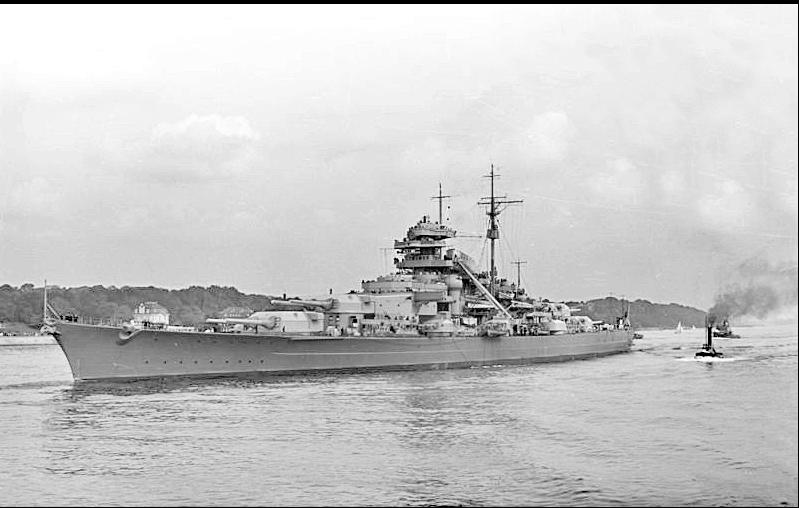
Air reconnaissance on the 21st May showed that BISMARK had left Bergen in Norway … and Intelligence believed that the ‘BISMARK’ was trying to get out into the Atlantic and make mincemeat of the convoys together with the cruiser EUGEN.
We left our base in Hralfiord on 23rdMay to back up our sister cruiser HMS SUFFOLK who was patrolling the Denmark Straight between Iceland and Greenland. On our way north we intercepted an enemy sighting report from SUFFOLK who was north of us.
After about an hours steaming we burst out of our fog bank into a clear patch of weather and there, horrors, about six miles away was a dirty big battleship and a cruiser. We were left in no doubt who they were, as almost immediately they disappeared in great clouds of smoke as their guns fired-six miles is spitting distance for naval guns. We turned hard starboard and made smoke but before we got back to our friendly fog bank there was a mighty rushing noise and several “plonks” as the German shells arrived and fell on either side of us… All we got were a few shell splinters inboard, some of which punched some wholes in my Walrus aircraft sitting on the catapult at the aft end.
We then,Contacted SUFFOLK, and together got down to one of the classic roles of the cruiser-shadowing-sitting out at maximum visibility distance keeping contact with the enemy. And sending periodic position reports by radio. The German ships headed south. Meanwhile the Commander in Chief, British Naval Forces ordered the nearest heavy ships, the battle cruiser HMS HOOD with 8 X 15inch guns and Battleship HMS PRINCE OF WALES with 12 X 14 inch guns to take care of the this upstart’ BISMARK . We in the cruisers NORFOLK and SUFFOLK were detailed off to flank mark, that is to observe and report the fall of shells.
The next morning, the 24th of May the two forces joined action. The British ships opened fire at 05:30. There were three survivors from the HOOD. PRINCE OF WALES received several hits from 15 ‘ and 8’ shells and with most of her bridge personnel killed, she broke off action. Both the cruisers steamed toward the German ships and fired our 8” guns, but after exchanging a few salvos our Admiral ordered us to disengage, which we did , reluctantly. The cruisers returned to shadowing with the battered PRINCE OF WALES tagging along before being detached for repairs.
Both SUFFOLK and NORFOLK had a primitive early form of radar (ASV) with a range of 13 miles that did allow them to keep tabs on BISMARK. Early in the evening BISMARK suddenly reversed course and started firing 15” shells at us. She nearly caught the SUFFOLK, who with us opened fire. No one was hit and after a time the BISMARK quit and turned back to a southerly course. We were mystified at the tactic, but it turned out later to be a diversion during which PRINZ EUGEN could make for France, which she did. BISMARK had received some damage during the action and had been slowed down a little.
To the north of us was the new aircraft carrier HMS VICTORIOUS. The aircrew were very green but managed to get nine Swordfish torpedo bomber airborne and at extreme range made for the BISMARK. They looked a bit raggedy as they flew over us and asked where the BISMARK was. The weather really was bad and they pressed home a brave attack., but made only one hit amidships and did not do much damage. This was the first attack in history by an aircraft carrier on a battleship. That night SUFFOLK, being almost out of fuel, was sent to refuel and NORFOLK was alone shadowing BISMARK. Then it got dark and horrors of horrors, we lost her during the night. At daybreak on the 25th the weather wasn’t too bad and I was sent for by the Admiral. He told me to get my Walrus ready to fly, we were to be catapulted off, found the BISMARK ,reporedt her position and made for Greenland as he couldn’t stop to recover us. We were 400 miles off Greenland, my aircraft cruised at 90 knots and there was a 40 knot headwind. As our endurance was 3 to 4 hours, it was a nail biting time for me and my aircrew. About 10:30 a battered old PBY flying Boat amphibian of the RAF emerged from the clouds and signaled by Aldis lamp that the BISMARK was 50 miles ahead of us. I had always considered the land borne fly boys a bit inferior but my views on the RAF did a rapid turn around.[3]
Royal Navy vessels from all over the Atlantic converged on BISMARK, including aircraft Carrier HMS ARK ROYAL. Fifteen torpedo bombers were launched from this carrier and in the very bad weather attacked the RN Cruiser HMS SHEFFIELD, which was shadowing BISMARK. Fortunately the torpedoes were N.B.G (no bloody good). Several exploded when they hit the water and others that did run did not explode beneath SUFFIELD. Returning to ARK ROYAL the strike force refueled , rearmed and took off at 10:30 for another go. This time they found their target. Only one hit was observed and a disappointed crew of naval airmen returned to ARK ROYAL. Next day air reconnaissance reported a strange thing-BISMARK- was steaming around in circles. During the violent maneuvers to avoid torpedoes, when her rudders were hard over, she had been hit in the stern and there they jammed-what luck! She then came to a full stop in the water. 08:15 hours on 27 May, we sighted the BISMARK again and signaled the battleship HMS KING GEORGE V which had 12 X 14” guns and the Battleship HMS RODNEY with 9 X 16 guns. At 08:47 the RODNEY opened fire followed by KING GEORGE V and then us. History credits us with the first hit but the battleships began hitting too. BISMARK’s return fire was sporadic and quickly stopped altogether. None of our ships were hit. She was hit time and time again and we were hitting her too. I saw one of our shells destroy the gunnery control position above the bridge and another hit the base of ‘B’ turret. At one time RODNEY seamed in front of us and fired a broadside, there were no shell splashes in the water. I suppose each shell exploded inside. When there was no return fire, the British ships stopped firing and asked BISMARK to surrender….There was no reply from BISMARK. I didn’t see how there could be anyone alive on her bridge or upper decks who could lower her colours (surrender) so we resumed firing-but she would not sink. We were not going to sink the BISMARK with guns. We being a cruiser, carried 21” torpedoes were ordered to deliver the coup de grace.
The NORFOLK missed its chance, and before it could muster a second try to torpedo BISMARK was order to leave because of low fuel. It was left to HMS DORSETSHIRE to put two torpedoes in each side of Bismark heeled to port, capsized and sank with her colours still flying. Steaming North East as fast as we dared being very low on fuel, we had to pass through German bomber coverage. And in due course we were attacked by a Heikel 111 . About 6,000 feet it started its bombing run and we let loose with our 4”high angle guns. Our shells went all over the sky as our roll corrector mechanism in anti-aircraft gun control system broke down. The German pilot made three runs before he released his load. They all landed very close to our starboard side. My Walrus, still sitting on its catapult was hit by bomb splinters, knocking a few more holes in it. We arrived without further incident at the last place God made, Gourock in Scotland and despite the lack of windows and holes in the Walrus, we hoisted it out into the water and managed to get it airborne and made a very drafty flight to our naval air base in Donibristle. I went on leave and got married and that was the Bismark episode as far as I was concerned.
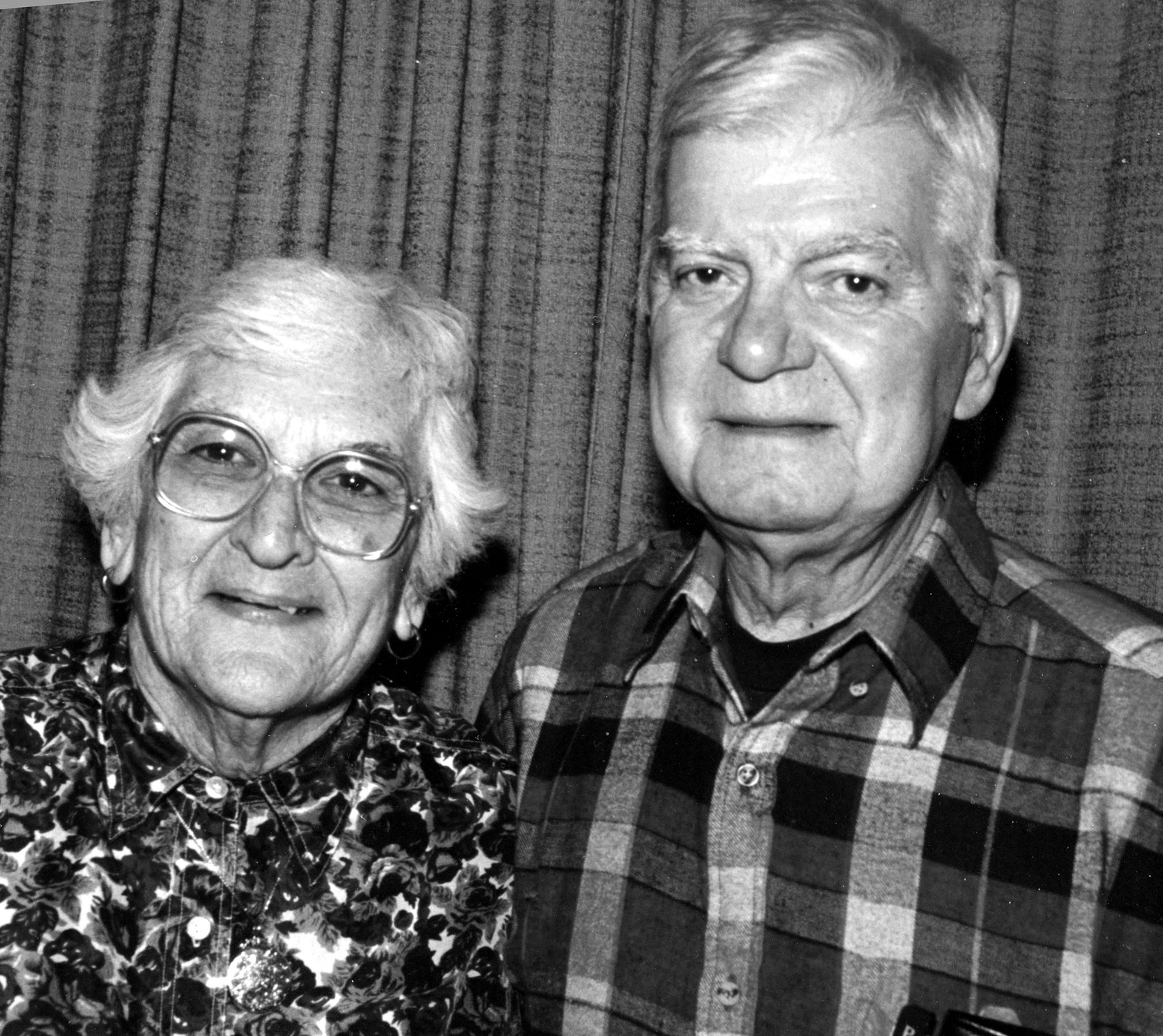
Sub-Lt ‘Dick’Forty RN married Thelma Bacon “seen above” an ATS operator on June 4, 1941.
Dick had secretly obtained a special license to marry at a registry office. When Dick approached her and presented her a crumpled piece of paper, she initially thought it was an off colored joke concocted by Dick and her brother Jack in the pub the two men had just exited. Her wedding dress was made from the bridesmaid’s dress that she worn to her twin sister’s wedding two days previously. The day after their wedding both headed back to their units and the war. Thelma Bacon had volunteered for the Auxiliary Territorial Service in June 1940. He first post was with Records Service in London, this department was eventually moved to Bournemouth on the south coast for fear that critical records would be lost because of the nightly German bombing raids. Later ATS Bacon volunteered for the signal corps and was trained at a special school where she and her classmates learned to intercept and record German Messages. Thelma graduated at the top of her class as the fastest receiver of all candidates. Thelma recalls one incident when all the girls of her unit were called “to a special meeting to learn that they were credited with saving an entire convoy as one of them- they were not told who- had intercepted a German signal which, once decoded allowed the convoy to change course and avoid a German ambush.”[4] Dick Forty remained in the Royal Navy after the war. In 1953 he was posted to Washington DC attached to the British Embassy. In America he made numerous inspection tours of US military and US Navy installations. In 2002, he mentioned that some of the things he saw are not known publicly and still considered ‘classified information’ 50 years later.
“During the time my family spent in Washington, we made a trip to visit, my dad’s sister, our Aunt Jose Somers in Calgary. Later she moved to Penticton and passed on stories of the Okanagan Valley. My dad became intrigued with growing apples in the Okanagan, and during the’ Great Bowler’ buyout of 1958 commuted much of the buyout and pension monies into cash. This cash was used to purchase a 14.2 acres orchard in Oliver B.C.. Although dad found Orchard work enjoyable, its income was sparse; so dad worked for the provincial Crop Insurance Program until his retirement.” [5]
The Fortys were active members of the Oliver Community; Dick was a Rotarian, School Board Trustee, an officer with the Oliver Air Cadet Squadron and Legion Member; Thelma helped out in the orchard, taught yoga, and still is active in the Rotary and Oliver Hospital Auxillary at age 96.
Notes
1. 110 German sailors survived BISMARK’s sinking from a crew of 2200. Publicity concerning BISMARK distracted public attention from the heavy losses suffered by the Mediterranean Fleet during the Battle of Crete where the Royal Navy lost six destroyers sunk, one aircraft and two battleships badly damaged.
Thank you Tim Forty of Naramata for your fathers notes and photo. The whole text of late Lt. Cmdr. R.F.J Forty’s notes can be found at the Okanagan Military Museum in Kelowna. The italicized text is from that document.
3“That PBY was my hero. I did not mind a bit about missing my posthumous DSO.” Dick Forty. Tim Forty-”If that RAF PBY had not arrived , my dad would not have made it back from that flight.”
Tim & Steve Forty recorded, with review assistance by Thelma Forty Summer 2014.
Tim Forty to Snyder May ’15.
Written prior to Thelma’s death
Thank to the extended family
Written by David Snyder of Penticton – a former teacher and war historian
Wait for more