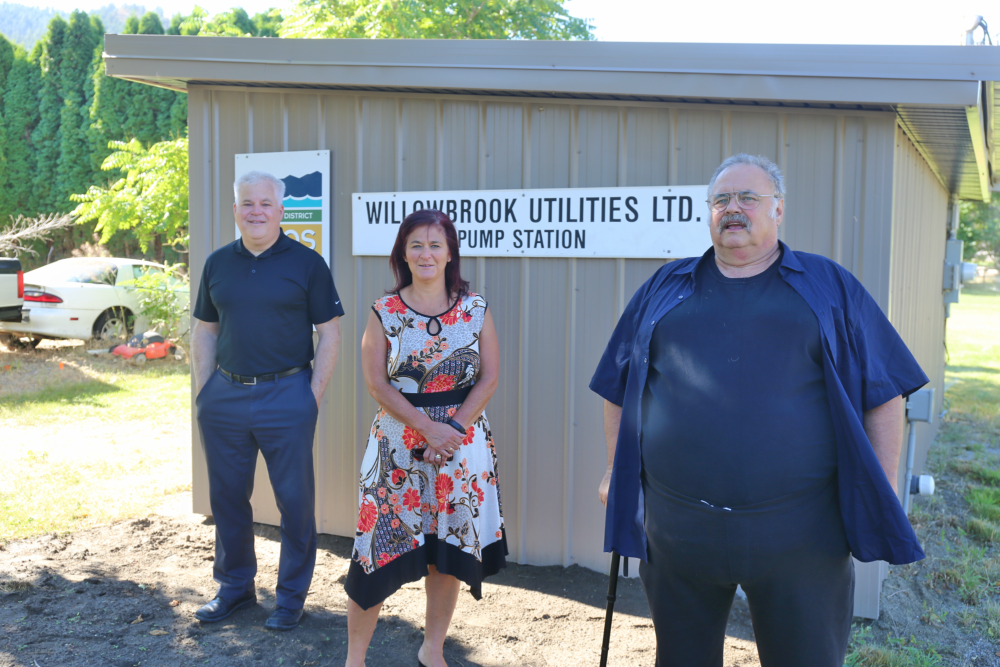
Left to right:
Andrew Reeder – RDOS Manager of Operations
Michelle Weisheit, Chair – Water Committee – Willowbrook
Rick Knodel, Rural Area C – RDOS
Willowbrook Boil Water Notice lifted
The Regional District of Okanagan-Similkameen (RDOS) has completed upgrades to the Willowbrook water system and has lifted the Boil Water Notice. The RDOS installed a chlorinator and chlorine tank at the Willowbrook pump station as part of the project. A Groundwater at Risk of Pathogens (GARP) study shows only chlorine is required to treat water in Willowbrook, and secondary treatment is not required at this time. Andrew Reeder, RDOS Manager of Operations says the upgrade will save Willowbrook residents between $500,000 and $600,000.
The Willowbrook water system is located within Electoral Area “C” between Oliver and Okanagan Falls. It provides drinking water and irrigation water to approximately 80 connections. “The improvements to the Willowbrook water system were completed with 100% grant funding,” says Area “C” Director Rick Knodel. “The work will not result in any tax increases for residents.”
“Lifting the Boil Water Notice is welcome news for all Willowbrook residents,” says Michelle Weisheit, chair of Willowbrook Water Advisory Committee. “We appreciate the time and effort that has gone into completing this project.”
Ownership of the Willowbrook water system was transferred from Willowbrook Utilities Ltd to the RDOS in 2016. The water source for Willowbrook water is a groundwater well which pumps into the distribution system to a reservoir on a nearby property. The reservoir feeds the distribution system of approximately 4.5 km of pipe, by gravity to each connection.
Background
The project funded primarily from Gas Tax Funding – so all the capital costs not bourne by local residents.
The Regional District’s current priority is focused on providing sufficient treatment that will allow the Boil Water Notice to be lifted for the system. A chlorine dosing system was added in 2018, however to be effective in disinfection, a chlorine contact system is required to extend the contact time of the chlorine before the treated water would reach the first service connection. With the installation of a chlorine contact time system, the water system will be able to protect against viruses (4-log removal) and bacteria (E. coli, fecal coliforms, and total coliforms).
Funding for the chlorine contact system installation is being provided through an allocation RDOS Electoral Area “C” – Community Works Gas Tax Funds from the Area Director. In August 2019, Associated Engineering started on the design for the Chlorine contact time system with construction planned for early 2020.