(Celebrating 110 years of Scouting in the South Okanagan)
To the Wilderness and Back
By today’s standards it might be difficult to conceive of two teenagers loading their backpacks for an overnight trek through forests and over mountains without knowing their destination before departure. On the morning of the challenge, their Scoutmaster delivered them to their starting point somewhere deep in the wilderness. They were handed a topographical map which showed their current location and, 20 km or more away, with an “X” on the map, their goal, where their Scoutmaster would pick them up at a specified time the following afternoon.
Using map and compass, the Scouts hiked the designated bushlands, and were required to perform several tasks along the way. The most critical task was to draw a highly detailed map of their route, showing universal mapping symbols for elevation, streams, trees, and whatever else they observed along the way. This had to be on such a scale that their Scoutmaster could literally follow in their footsteps along the entire route. They were required to camp overnight and prepare specific meals along the way. Other options might include exploring for elevation markers on hilltops or, perhaps, reporting on the flora and fauna encountered in specified areas.
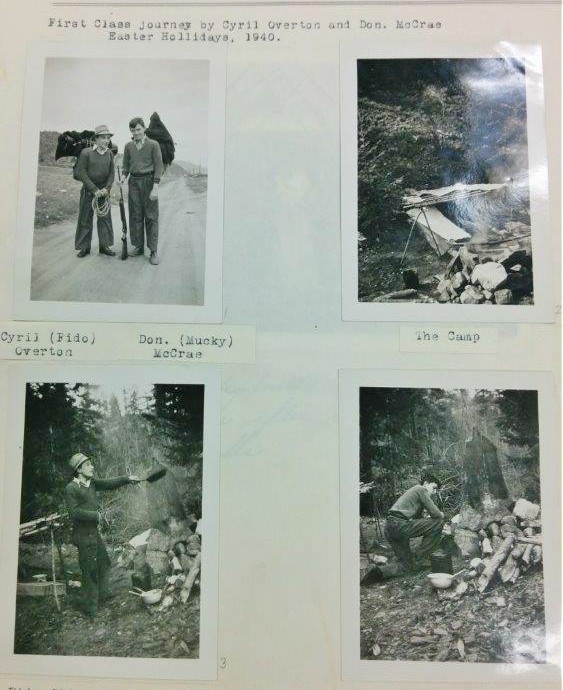
When they were done, the Scouts created a logbook which told the story of their journey, including a list of the camping gear they carried, their menu, and observations about their camp. Most of these logbooks have disappeared, but the Oliver Museum has managed to preserve some of them. The books from David Berryman and Harold Dieno, in 1939, and Cy Overton and Don McRae in 1940, are among them.
How were these journeys possible? It began in a meeting hall with endless instruction and practice in tying knots and learning how to build wooden structures using only ropes. Then there was map and compass work, followed by basic camping skills. Scouts learned how to set up a camp for all weather conditions, how to light a fire and how to prepare simple but nutritious meals in the bush. From the meeting hall those skills were taken outdoors for evening hikes and weekend camps where theories were put into practice.
This particular challenge was known as the First Class Journey, and was part of the progression toward First Class status and, ultimately, King’s/Queen’s Scout awards. It was highly popular for Scouts, but was discontinued approximately fifty years ago. Those were different times for teenage boys. Many thanks to the adult volunteers in Scouting who instilled the necessary outdoor skills in their Scouts so they could be successful in this character building adventure.
This is just a sampling of the stories that will unfold at the Oliver Museum when it opens this week with a seasonal display of the history of Scouting in Oliver and the South Okanagan.
Gerry Lamb
Photos courtesy Oliver and District Heritage Society