Yusuf Losuto
When I am tempted to complain about the inconveniences and destructive consequences of the current health and economic crises, I am wise to remember the following personal encounter during the year we were in Africa.
When my wife and I were in Kijabe, Kenya on a one-year short term mission, Yusuf was a student in one of my classes at Moffat Bible College. Some students would typically invite the teacher to come to their villages for a weekend. It would include visiting and preaching. I would gladly go every time I was asked, so when Yusuf invited me I agreed to go. I might have hesitated had I known the background to his story.
At age 12 his job was to be the goat herder for his father. The Pokot tribe Yusuf was born into was a nomadic tribe in a remote area of Kenya. Life was very difficult due to poverty, semi-desert conditions and tribal conflicts. Yusuf and 6 other goat herders his age were attacked by Turkana rustlers on horseback. The boys had spears, the Turkana had guns. Yusuf managed to hide under a bush. The other 6 were killed.
Understandably, Yusuf pleaded with his father to let him go to school instead of herding goats. His father refused because school wouldn’t make him a better goat herder. Yusuf didn’t want to herd goats – also understandable – so he ran away to a school run by missionaries. The father came to haul him back home but Yusuf fled again. This time the father threatened to kill him if he ran away again. “You won’t have to,” declared Yusuf. “I’ll just commit suicide.” The mother intervened and Yusuf got to go to school when a missionary agreed to pay for it. He started school at age 12 in a language (English) that he didn’t know. He stuck it out, graduated, became a Christian and was now (1992) a student a Moffat with the goal of going back to his tribe as a pastor. By this time the father’s attitude had mellowed.
Yusuf the Pokot, Biwot the Kalenjin, Dixon the Maasai and John the Kikuyu piled into my car. After the pavement and the gravel road petered out we drove through wilderness until the acacia thorn bushes prevented further progress. We passed a gravesite where Yusuf’s grandfather was buried. He was a Pokot hero for killing 100 Maasai enemies. I have a picture of Yusuf and Dixon shaking hands over his grave. We walked until we spotted beehive-shaped huts that served as this clan’s living quarters.
I say ‘clan’ because the father had 4 wives and a large family as you see in the picture.
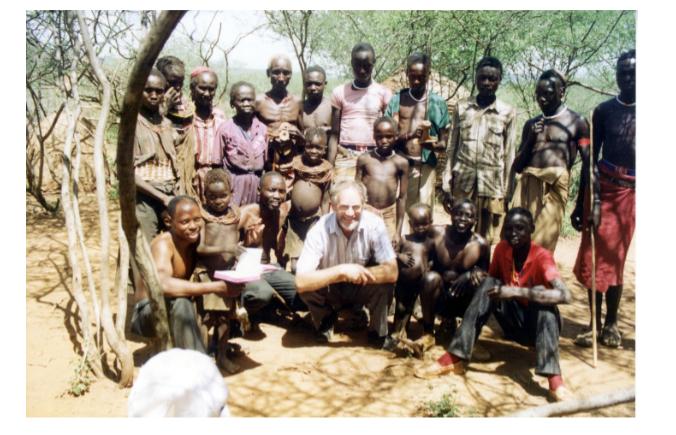
Each wife had her own hut that she had constructed herself, a 2-day project each time they moved unless a previously built hut was still there. A tree branch cot with a goat skin was the bed, 3 stones served as the kitchen fireplace and a few ‘tools’ and a spear hung on the wall. Some metal cups and a plastic pail told me it was the 20th century, not the 15th. At the father’s command the whole clan gathered to listen to this white man, a rare guest. Some were visibly reluctant.
The idea of a Creator is generally accepted in these tribes so I briefly traced the story from creation to the cross, with Yusuf as interpreter. The focus was on God’s loving provision and forgiveness. There followed traditional expressions of thanks to the guest.
Then Yusuf and his brother brought a goat to me and asked if it was good enough. Puzzled, I said it certainly was but Yusuf decided to get a better one. There in front of me, while one person lifted the front legs, Yusuf plunged a spear into the goat’s heart, caught the blood in a bowl, and brought the goat to the women for meal preparation.
The men and some of the boys went for a walk where I saw a pond available to cattle and wild animals. This was the better source of water. A green algae covered the brown water in a slough that was the other option. The meal was delicious except for the chai made of tea and either goat’s milk or camel’s milk. I had seen the water source but refusing hospitality was a great insult.
Within one hour after the 6 hour trip back to Kijabe I became really sick for three days. I believe it was the Lord who kept me healthy long enough to drive back. There was no other driver.
Two weeks later I went on another ministry trip with a different student. I wanted to do what I could during the one year I was there.
Henry Wiebe