The South Okanagan Boy Scout movement is celebrating its 110th Anniversary this year. Scout Troops were first established in Summerland and Penticton by 1910, with Naramata following in 1912. During the years of the 1st World War, Troops appeared in Hedley and Keremeos, with Cawston not far behind.
The first Troop in Osoyoos was shortlived from 1922 to 1923, organized by the Reverend Elliot. Although there is limited photographic evidence that a Troop existed in Oliver in the mid 1920s, no documents have yet been found to supply further details.
In late 1931 the “Oliver Boy Scout Association” was created, with support from the community, churches and service organizations. The McNaughton and Ritchie families were heavily involved with this. That first year saw both a Wolf Cub Pack, under the guidance of Akela T.R. Joel-Taylor, and a Scout Troop consisting of 40 youths under the Leadership of P.C. Coates and Bob Hall.
While we have been able to locate and archive many documents and artifacts from the years leading up to 1972, there are still vast gaps in our knowledge. The towns south of Penticton were loosely grouped in a District known as Kobau or Okanagan Boundary. Very few written records are available, such as Minutes of District Council Meetings. In 1972, the Okanagan Boundary area was merged into South Okanagan District, stretching north to Summerland and Naramata. Extensive records of District meetings dating back to 1945 are in the Penticton Museum and Archives, and this includes Oliver, but only after 1972.
The late James Harper Mitchell first emerged as District Commissioner for Scouting in 1932. In 1935 he got further involved when he took on the additional role of Scoutmaster, with Carleton McNaughton and Ken Thompson assisting. And thus began decades of highly successful Scouting in the area. McNaughton took over the Scout Troop two years later, and would have a strong influence on the lives of countless boys not only in Oliver, but throughout the entire southern Okanagan.
In 1948, a former Oliver Boy Scout, Cyril Overton, stepped in to assist McNaughton. Two years later he became Scoutmaster, freeing up McNaughton to work on a larger stage.
Researching history can lead one in many directions. Study a picture, document or artifact long enough and often a story emerges. Sometimes we have been able to “repatriate” local items of significance that had vanished. In the early years of Scouting, as now, a Troop is divided into small groups, known as Patrols. At one time, each Patrol would have a Bugler, and Oliver was no exception.
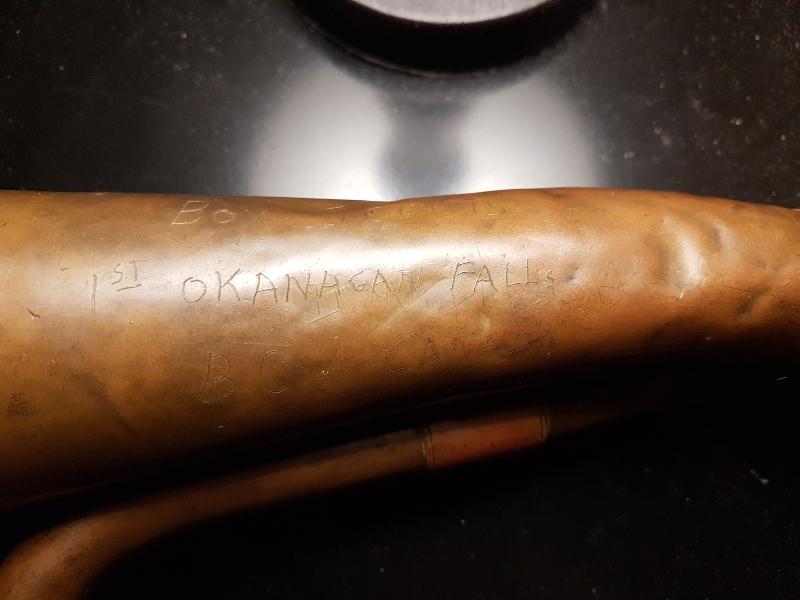
Wesley Overton had a bugle upon his return from the 1st World War. It was played many times on Remembrance Day and at Scout Camps, and then it disappeared. Two years ago it showed up in Summerland, where it had been hiding in plain sight for forty years or more with no one aware of its historic significance. Scratched on the bugle is the following: W Overton World War I 1914 1918. On the opposite side the following is scratched into the bugle: Boy Scouts 1st Okanagan Falls. It was a well-travelled bugle, and its full story is not known. It has, however, found its true home in the Museum at the Oliver and District Heritage Society.
Gerry Lamb is the Interim Chair of a group of mostly retired adult Scouters who have spent nearly nine years preserving the history of Scouting in our municipal museums.
Gerry Lamb
Photo by Lamb
contributed material copyright