By ROY WOOD
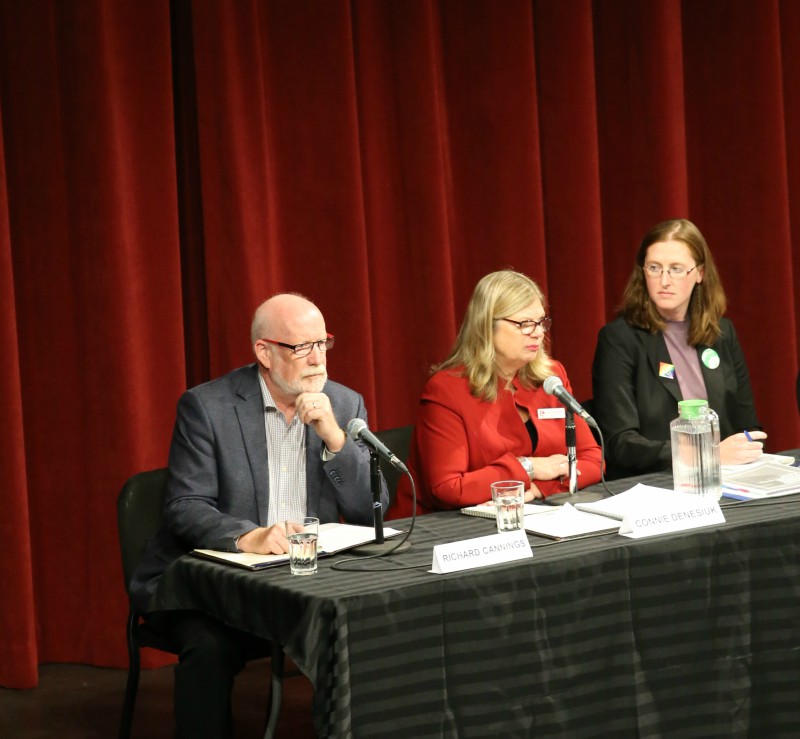
The mood was political but polite at the Frank Venables Theatre Wednesday evening as the candidates from the five national parties answered questions on a broad palate of local and national issues.
The event was the first Oliver/Osoyoos forum featuring the candidates seeking the South Okanagan-West Kootenay seat in the October 21 federal election.
National Park Reserve
Predictably enough, the first question focused on the wide divisions in the South Okanagan about the proposed National Park Reserve.
Incumbent Richard Cannings of the NDP, who supports the park, agreed there are divisions, but noted there is “a lot of misinformation out there.”
He said he has taken the concerns of the local population to the appropriate federal ministers. He said the park now under discussion with the province and the Osoyoos Indian Band is considerably smaller than originally proposed.
Canning added that consultations with locals have led to agreements that there will be no expropriations for the park and that ranching and the established helicopter school will be allowed to continue.
Liberal Connie Denesiuk, said she is also in favour of the park. There is polarization, she agreed, partly because “difficult conversations haven’t been had.”
She touted herself as someone who can “bring people together” and will use those skills to get the community past its disagreements.
Helena Konanz, the Conservative candidate, made the point that as a member of “the third party,” Cannings hasn’t had a seat at the table on the national park issue and that it’s important for the community to have an MP who is part of the government.
Gallagher Lake Syphon
A question about the syphon and why it hasn’t received federal funding was directed at Denesiuk, who spent a fair bit of the evening defending the record of Prime Minister Justin Trudeau.
She said the syphon is “of great concern to me,” but that she wasn’t involved in the decisions and doesn’t know why the federal government hasn’t moved on the file.
Canning said that when the syphon was damaged three years ago, he assumed that federal help “was a no-brainer,” and he was astounded that there was no federal program under which the repair could be funded.
Green Party candidate Tara Howse said her party has a national infrastructure plan that will see one per cent of the GST go toward building and maintaining essential infrastructure like the syphon.
Konanz used the question as another opportunity to point out the ineffectiveness of having an MP not from the governing party.
The failing forestry sector
Howse responded first to a question about what can be done to address the bleak state of the forest industry in BC, suggesting a good place to begin would be to stop exporting raw logs and start processing more of the wood here.
She added that the Green Party has proposed creation of a “national forestry strategy” to better deal with the issue.
Sean Taylor, a political neophyte running under the People’s Party of Canada (PPC) banner, took an oblique turn and prescribed the elimination of Canada’s supply management system – which pertains almost exclusively to agricultural business.
He said this move would make it easier for the country to complete international trade agreements, thereby improving the export prospects for lumber.
Cannings pointed out that part of the problem has to do with the diminishing number of trees because of forest fires and pine beetles. He said there needs to be more local processing so that the BC industry can “increase the value of each tree cut.”
Increase property crime
Konanz prescribed the old standby of “stopping the revolving door,” which sees repeat offenders moving through the police, the courts, into jail and back out on the street committing crimes again.
She offered no specifics on how to stop the cycle, but suggested her party’s solutions would include compassion for people who are addicted or mentally ill.
Howse countered that the “revolving door of criminals” are precisely those with addiction and mental health issues. What is needed, she said, are programs that address the underlying root causes.
Cannings agreed, suggesting that treatment programs need to be enlarged and drugs decriminalized as part of a strategy to address the issue. He said the federal Conservatives fight such initiatives “tooth and nail.”
Taylor hoisted the UPC’s libertarian flag, suggesting that “no one’s accountable for what they do anymore.” While offering no solutions, he suggested that law-abiding citizens “cannot be held hostage by these people.”
What about the deficit?
Denesiuk raised a spirited defence of the Trudeau government’s abandoning of its pledge to eliminate the federal deficit, which she said her party inherited from the Stephen Harper Conservatives.
The government has been investing infrastructure. “What’s the point of having a balanced budget,” she posited, if our infrastructure is failing and our children can’t get a decent education?
As well, she said, Canada compares very well with other developed countries in its debt to GDP ratio.
Konanz asked rhetorically: “If Justin Trudeau has four more years, how much more debt” will the country face?
While not commenting directly on the federal deficit, Cannings pointed out that NDP provincial governments have balanced their budgets 40 per cent of the time, compared to 23 per cent for Liberals and 33 per cent for Conservatives.
The PPC is the “only fiscally conservative party” in the race, said Taylor, and leader Maxime Bernier has pledged to balance the budget in two years.
Paying for promises
In answer to a question about how the Green Party would pay for its promises, Howse suggested more taxes from the rich and for corporations and closing off access to off-shore tax havens.
Taylor said the PPC would start by defunding the CBC, saving $1.5 billion, and would garner another $5 billion through eliminating unspecified “corporate welfare.”
Marijuana prisoners
In light of the recent legalization of marijuana, the panel was asked if they would release “marijuana prisoners.”
Konanz answered with a simple, “no,” but then wondered out loud how many of them there are and whether they might be in jail for some other crimes. She did pledge, however, that the Conservatives have to plans to repeal marijuana legalization.
Taylor asked, “Is that a thing?” but offered no answer.
Cannings said that criminal records for simple possession of marijuana can be burdensome in many ways and urged that such records to need to be “expunged.” He said the liberals seems happy with pardons, which don’t go far enough.
Denesiuk agreed the records should be expunged and went on to praise the legalization for gradually getting rid of the illegal market and protecting children.
The candidates:
Richard Cannings, NDP … A professional biologist before being elected as MP in 2015. An avid birder and outdoor enthusiast
Connie Denesiuk, Liberal … Long-time school trustee and chair of the board of governors at Okanagan College. Recently completed a masters in “Leadership Studies.” Running for the second time.
Helena Konanz, Conservative … Two-term Penticton city councillor. Operates a chiropractic clinic. Former professional tennis player. Running federally for the first time.
Tara Howse, Green Party … Over 15 years on not-for-profit organizations and volunteer boards. Avid outdoor enthusiast. Running for first time.
Sean Taylor, People’s Party of Canada … Armed forces veteran. Emergency Medical Technician and Emergency Room registered nurse. Running for first time.