By ROY WOOD
No decision has been made on whether there will be a national park reserve in the South Okanagan and it will likely take another two years to reach an agreement to create one.
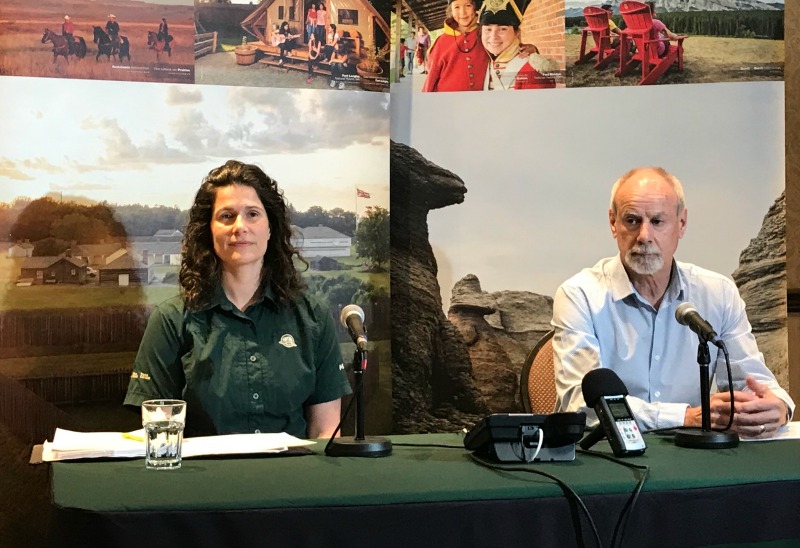
Those are two things that came out a news conference in Penticton this morning, at which Parks Canada officials continued efforts to convince area residents of its commitment to an open and consultative process.
The purpose of the news conference was to discuss a consultants’ report called What We heard, a compilation of what Parks Canada project manager Sarah Boyle describe as: “(B)road and extensive consultations with local residents, stakeholders and Canadians to hear their views on the proposed boundary for the national park reserve … and key aspects for consideration in its management.”
According to Boyle, Parks Canada hopes to finalize a boundary for the proposed park reserve by this summer.
“(But) no decision has been made on the establishment of a national park reserve,” Parks Canada director of protected area establishment Kevin McNamee told reporters as he outlined the next steps in the process that began nearly two decades ago.
Emphasizing the point later, McNamee said he couldn’t answer specific questions about park management details because “we have to earn the public’s trust (that) we don’t have this cooked up. … We will keep seeking public consultation.”
Regarding the next steps in the process, McNamee offered the following:
- There is a series of four public meetings this week, in Osoyoos, Keremeos, Oliver and Penticton to present the What We Heard report.
- The results of the report and other public consultations will be taken to the national park reserve steering committee, which includes representatives from the federal and provincial governments and area First Nations.
- Out of the steering committee is expected to come a non-binding memorandum of understanding (MOU), including the park boundaries. According to McNamee, the MOU would simply be an agreement to move to detailed negotiations.
- Then the negotiations among the parties would commence, possibly taking several years. McNamee took the time to emphasize that Parks Canada is specifically prohibited from using expropriation of private land in assembling a park land base. It must be a “willing seller, willing buyer” process for acquiring privately owned land, he said
- The final step would include the signing of an agreement among the parties and appropriate federal legislation under the National Parks Act.
McNamee, who said he’s been involved with these sorts of projects for more than 30 years, said his “personal estimate” is that once the MOU is signed this summer, it will likely take about two years to negotiate the final agreement.
As for specific concerns about recreational or agricultural uses of the proposed reserve, the pair would offer neither reassurances nor warnings, pointing out that such details would be part of future consultations and negotiations.
First Nations’ concerns were not addressed in the What We Heard report, said Boyle, because they are “holding self-led community engagement as a separate process with members of their Indigenous communities to determine support within the Okanagan Nation Alliance.”
However, First Nations are integral to the process, being one of the three parties on the steering committee. McNamee said Osoyoos Indian Band Chief Clarence Louie is in agreement with the park reserve project “as long as First nations concerns are met.”
The reason the project is referred to as a national park reserve rather than simply a national park, flows out of increased Indigenous peoples’ rights awareness in the 1970s and 80s. McNamee said park reserve is the term used when the land in question is the subject of unsettled Aboriginal land claims.
Such reserves are “managed the same as a national park,” but with cooperative management with First Nations.
Cattle ranching and grazing is a major issue in the South Okanagan proposal, with a large portion of the land in question being used for cattle. Said Boyle: “The support of ranchers is critical to moving forward. … (We are) just in the preliminary stages of what will be the management plan for grazing.”
About 10 journalists attended this morning’s news conference at the Ramada Inn in Penticton this morning.