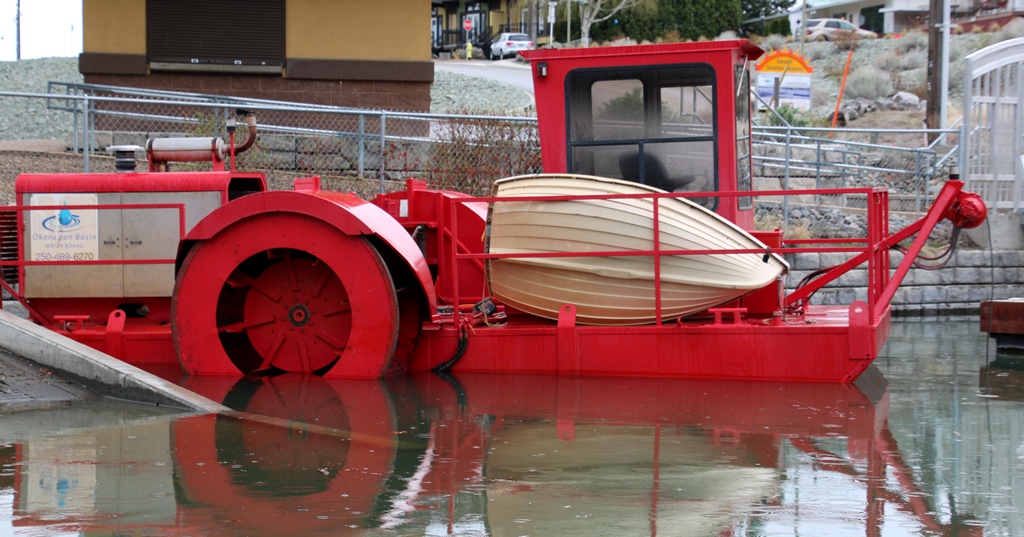
 Since the 1970s, the Okanagan Basin Water Board has run a program to remove invasive Eurasian milfoil from the five large lakes in the Okanagan (Okanagan, Kalamalka , Wood, Skaha and Osoyoos).
(Interesting that Vaseux not included in this list)
Most public beaches throughout the valley are free of invasive weeds due to this program. However, recent changes in provincial and federal regulations are increasingly affecting our most effective treatment method, rototilling in the winter. Rototiiling de-roots milfoil from the lake bottom, reducing stem densities by 80-97% in a single treatment. Rototilling is now prohibited in several areas under provincial regulations.
This recent rototilling prohibition is due to federal and provincial government staff efforts to protect a species of freshwater mussel known as the Rocky Mountain Ridged Mussel (RMRM).
These mussels range from southern California, East to Nevada and throughout the Pacific Northwest, but in Canada they are limited to the Okanagan Basin, which represents only 5% of their total population range. Prior to 2003 there had been only 14 occurrences of the RMRM recorded in the Okanagan, and the Committee on the Status of Endangered Wildlife in Canada (COSEWIC) recommended that they be listed as “Endangered” under the Species at Risk Act (SARA).
However, more recent surveys have found healthy populations with successful reproduction rates in several areas throughout the valley. One study in 2015 counted more than 5,500 RMRM in just nine surveyed sites, and estimated the total population at those sites to be more than 13,000. COSEWIC has not re-assessed their recommendation since 2010, and has not accounted for this new information.
Further, November 2011 was the last time that Canada’s Department of Fisheries and Oceans conducted public consultations on the recommendation to list RMRM as endangered under SARA. Milfoil rototilling is now prohibited in any areas where RMRM are found based on an assumption that this weed control method could cause harm to RMRM. However, there is evidence to suggest that allowing milfoil to grow will create conditions which are unsuitable for RMRM, while also creating poor water quality, poor habitat for other species, as well as social and economic harm.
Source: Okanagan Basin Water Board
Letters sent to:
Minister of Fisheries and Oceans
Minister of Forests, Lands, Natural Resource Operations and Rural Development asking both to grant an authorization under the federal Fisheries Act for the milfoil control program to continue.
OBWB strongly believe that a more evidence-based and balanced approach is needed before prohibiting milfoil de-rooting and allowing this invasive weed to thrive in our lakes.
OBWB has almost a million dollar annual budget amount paid by local taxpayers to clean the lakes of milfoil.