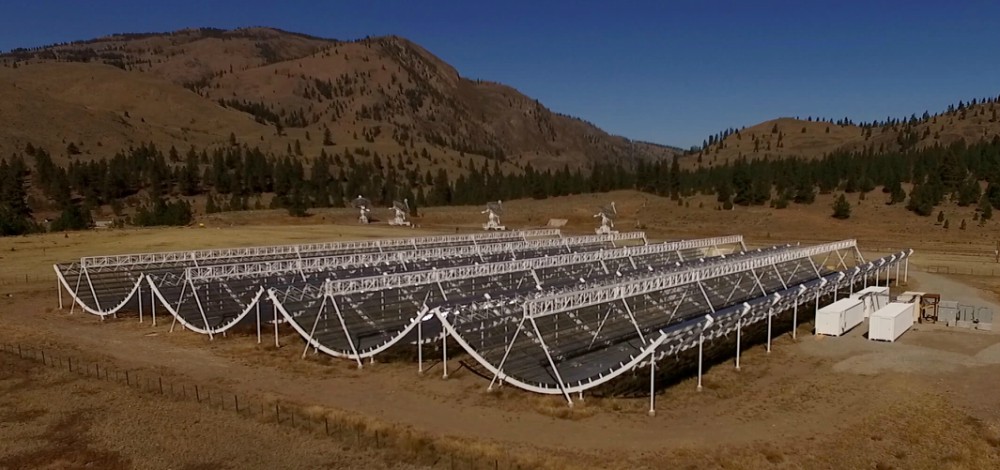
DRAO at White Lake, north of Willowbrook
A new radio telescope in British Columbia’s Okanagan Valley (technically not in the valley) has detected 13 new sources of mysterious extragalactic phenomena known as fast radio bursts, including the second known source of repeated bursts.
And the experiment is just barely getting started.
The Canadian Hydrogen Intensity Mapping Experiment, or CHIME, picked up the radio signatures of the bursts over the course of three weeks in July and August, while the telescope was in its pre-commissioning phase and running at only a fraction of its design capacity.
CHIME is a fixed radio telescope that covers more area than a football field and passively scans the skies 24/7 as Earth rotates. It was originally designed to delve into the mystery surrounding dark matter by mapping the distribution of interstellar hydrogen, but it also turns out to be well-suited to take on the mystery surrounding fast radio bursts.
Fast radio bursts, also known as FRBs, are powerful spikes of radio emissions that emanate from galaxies beyond our own Milky Way and last for mere milliseconds. Only 60 FRB sources have been detected, including the 13 announced today.
“Their origin is still unknown,” said the University of British Columbia astronomer Deborah Good, one of the co-authors of two papers about the detections published today by the journal Nature.
source: CBC
DRAO: Dominion Radio Astrophysical Observatory