 Development Variance Permit Application — Electoral Area “C”
Purpose: To vary the parcel coverage for buildings and structures in an agricultural zone.
Owners: David & Wanda Casorso – 164 Secrest Hill Rd
OCP: Agriculture (AG) Zone: Agriculture Two (AG2)
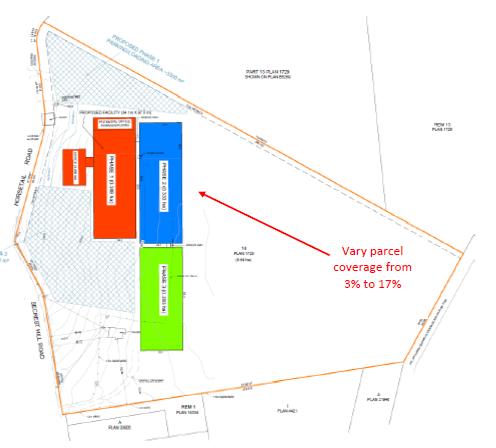
Variance Request: To vary the maximum parcel coverage from 3% to 17%.
Administrative Recommendation:
That the APC recommends to the RDOS Board of Directors that the subject development variance permit application be approved. Rural Directors voted 6 – 2 for a a development permit. A license must be obtained from the federal government prior to development.
Source: Castanet
Development:
This application seeks to vary the maximum parcel coverage for building and structures in the Agriculture Two (AG2) Zone from 3% to 17% in order to allow for the development of a medical cannabis production facility.
The applicant has noted in their application submission that if the proposed variance is not successful, the owners will proceed with a greenhouse option, which would not require a parcel coverage variance. In support of the requested variance, the applicant has stated that requested “variance does not defeat the intended bylaw, due to the fact the building will be used directly for agriculture production. In addition, the alternative to this building, would be a larger coverage of greenhouses.”
Site Context:
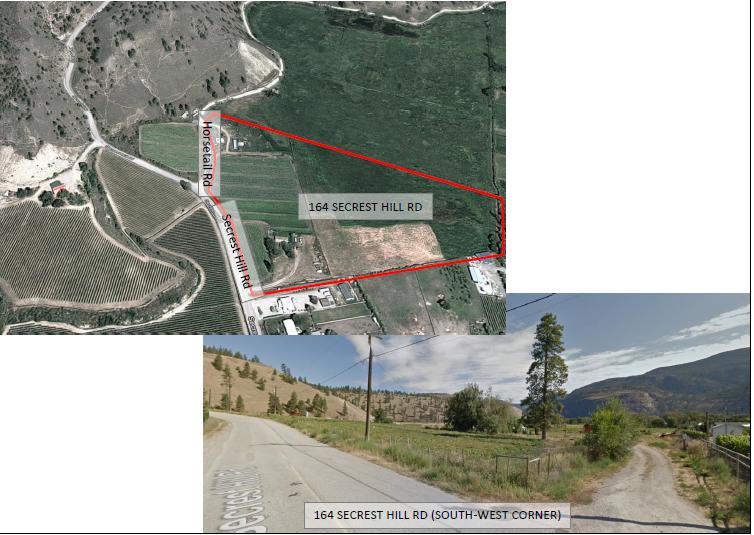
The subject property is approximately 6.72 ha in area and is located on the east side of Secrest Hill Road, north of Highway 97, and approximately 4.5 kilometres north of the Town of Oliver. The surrounding pattern of development is predominantly agricultural with a low density residential subdivision immediately to the south of the subject property.
Background:
The subject property was created by a plan of subdivision deposited with the Land Titles Office in Victoria on May 25, 1921, while available Regional District records do not indicate the issuance of any building permits for this property.
Under the Electoral Area “C” Official Community Plan (OCP) Bylaw No. 2497, 2012, the property is designated Agriculture (AG) and comprises Important Ecosystem Areas under Schedule ‘C’ of the bylaw.
Under the Electoral Area “C” Zoning Bylaw No. 2453, 2008, the property is zoned Agriculture Two Zone (AG2) Zone, and the bylaw establishes the maximum parcel coverage for parcel greater than 0.8 ha but less than 12.0 ha in area as 3%.
The owners of the property propose to grow medical cannabis on the subject property. As per Health Canada regulations cannabis must be grown indoors as outdoor growing is not permitted. There are two options for growing medical cannabis indoors:
1. Indoor growing (a closed building that uses using lights/lamps to grow plants)
2. Greenhouses (a transparent structure that uses sunlight to grow plants)
In the AG2 Zone the maximum parcel coverage for buildings and structures is 3% and the maximum parcel coverage for greenhouse uses is 75%. Based on the owners’ desired yield of 30,000 kg/year of cannabis a large greenhouse is needed.
Analysis:
When assessing a variance request a number of factors are taken into account. These include the intent of the regulation; the presence of any potential limiting physical features on the subject property; established streetscape characteristics; and whether the proposed development would have a detrimental impact upon the amenity of the area and/or adjoining uses.
The purpose of establishing maximum parcel coverage regulations is to restrict the size of building footprints on a parcel, and the maximum parcel coverage for the AG1 Zone was reduced from 15% to 3% with the implementation of the Electoral Area “C” Agricultural Area Plan (AAP) in 2011.
The intent of these changes was to “reduce the on-farm footprint, limit site coverage by non-farm structures while not limiting productive farm structures; allow more flexibility in the use of buildings. Encourage clustering of development on farms, encourage ‘stacking’ of farm use buildings.”
Administration recognizes that indoor growing facilities such as the proposed buildings are an anomaly amongst farm use buildings and warrant site specific consideration. In support of this proposal, the applicant is seen to meet the intent of the AAP recommendations through the siting of the buildings, the ability to ‘stack’ cannabis plants, and the use of the buildings for a farm use.
Administration recognizes that if the applicant were to pursue the alternative option of growing medical cannabis in a greenhouse the building footprint would be larger than an indoor growing building. This is because plants can be stacked vertically in an indoor growing building as the plants do not need to access sunlight.
Source: RDOS