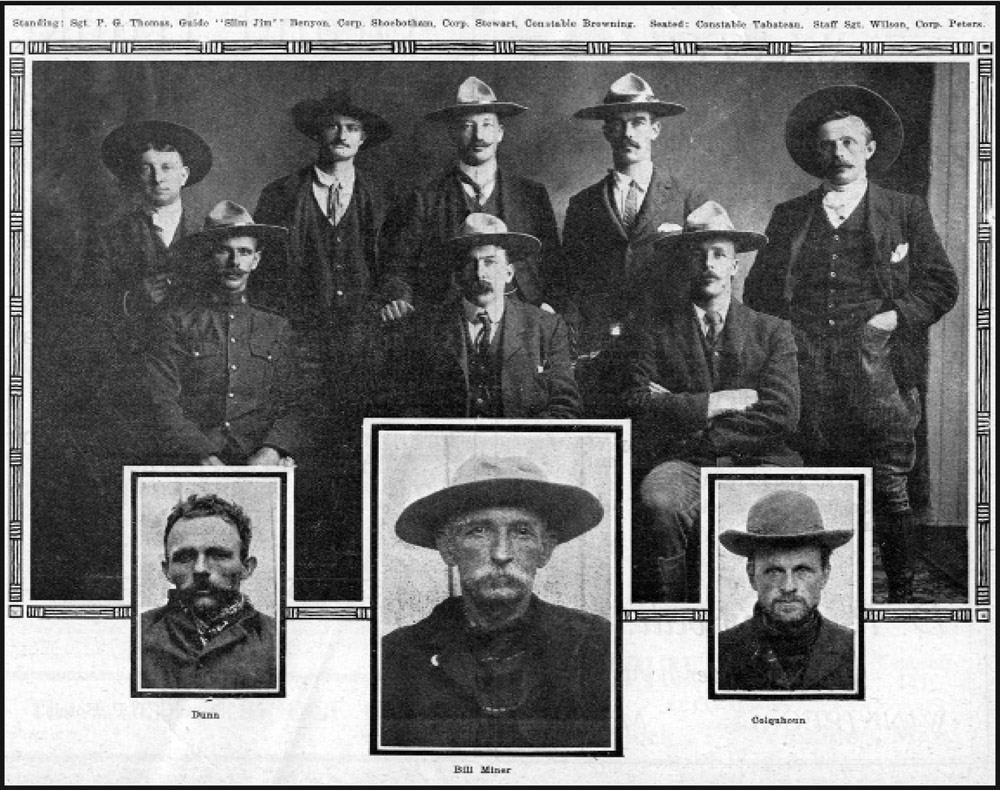
 On May 20, 1873, the House of Commons passed the act establishing the North West Mounted Police. But it was really the notorious robber, Billy Miner who was responsible for this Police force coming to the West. In May 1906, Bill Miner, along with two companions, held up a train. The authorities were alerted by the unusual circumstances, and the Provincial Police sent a wire for a detachment of the famous Mounted Police to come up and aid in the hunt for the desperadoes.
After their capture, Superintendent R. Marpole of the C.P.R., who took special interest in the arrest of the outlaws, made a public statement strongly advocating that detachments of the Mounted Police should be brought to this province, where their devotion, skill, courage and endurance would have a deterrent influence on crime. In time, the plan which Mr. Marpole had the foresight to advocate had been carried out to the great benefit of this province.
However, very few recognize that the earliest police work was in reality done in British Columbia. With the establishment of the Crown Colony of Vancouver Island in 1858, Sir James Douglas, then Governor, wisely provided for a properly organized constabulary, the scope of which later included the mainland of B.C. This early force predated the Royal North West Mounted Police by about fifteen years. Thus B.C. has the proud honour of maintaining the oldest police organization west of the Great Lakes – formed when the cities of Winnipeg, Regina, Calgary and Edmonton were not yet born. Elsewhere, nomadic Indian bands still roamed, but one the westward traveller had crossed the Rockies, however, they were soon aware that law and order existed here.
The period between 1858 and 1868 was a colourful one, and the police had a difficult task to perform. With the discovery of gold and the first rush of miners to the Fraser, and its tributaries, came clashes between whites and Indians. The majority of the miners were from the California fields, and the more lawless element were rather “quick on the trigger” when they thought their rights were being interfered with by the natives. Luckily, Governor Douglas had endowed the force with a strict and capable Commissioner, in the person of Augustus F. Pemberton. The population of the colony increased by thousands almost overnight and it became the duty of the police to educate the miners in British law, which they were quick to do.
When the Canadian Pacific Railway was extended to British Columbia and the settlers began to move west the Militia had to keep order in the camps, prevent fighting and stealing, and keep roads clear. The train robbers, the whiskey pedlar and the cattle thief gave way somewhat to labour troubles in connection with railroad construction, and with shipping. The automobile made its appearance, and legislation for its regulation was on the way. Many areas had become incorporated cities and town, and the policeman found life and the law, becoming a much more complex affair.
Prior to 1924, the force was strictly a provincial one with orders coming from offices in the main centres. After this period, Municipalities could apply for a force of their own, governed through a local office. Thirty eight cities applied by 1937. The province was divided into 5 divisions with each division divided into districts and detachments.
A training centre was opened in the lower mainland and enlistment proceeded. Enlistment was open to British subjects of good character between the ages of 21 and 35, with a minimum height of 5’ 10”.
The duties of this force were multifarious. Not only responsible for the Provincial Statutes and the Federal Criminal Code, the force became responsible for many other facets of the Provincial Government. Many officers were required to act as District Registrars of the Marriage Act, Deputy of Mining Records, Sanitary Inspectors, Brand Inspectors, Weed Inspectors, Assistant Fire Chiefs and much more.
After 1924 the Province instituted the Motor Vehicle Branch. This provided the BC Police Force with access to information to enable enforcement of driving infractions. The work of this branch was cited as a model for the Dominion.
Through the years, The BC Provincial Police has watched with friendly interest, the growth of the North West Mounted Police and between the two organizations there has always existed a fine spirit of mutual helpfulness and regard.
And so the force moves on…keeping ever in mind the ideals of its founder, and the spirit of devotion to duty which the “old-timers” left as their heritage. British Columbians may well be proud of their constabulary.
Written by Brian Wilson, editor of Archivos – magazine of the Okanagan Archive Trust Society