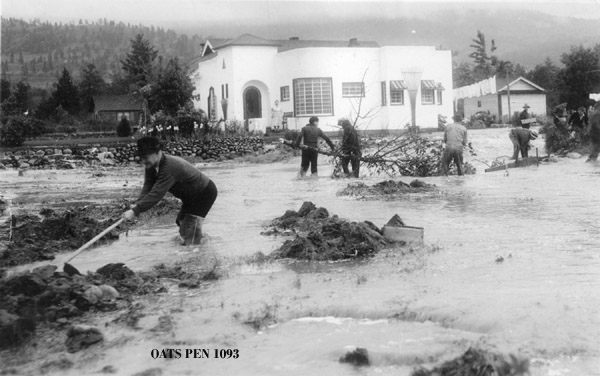
 The south Okanagan Native tribes knew better than to set any permanent settlements down in the bottomlands surrounding Okanagan River. They just shook their heads at the advancement of European settlers into the wet areas of Penticton’s townsite.
Right from the humble beginnings of Penticton, Naramata, and Okanagan Falls; floods were a regular spring event. As colonial imports, we ignored warnings and just weren’t prepared for the annual freshet.
The pattern was clear in reports from the press: “Penticton Creek Dam Overflows Spillway” May 25, 1912. “Creek Breaks Bounds – Freshets cause washouts” May 17, 1913. “Creek Breaks Bounds – Property Damaged” May 16, 1914. Then the worst in 1921, “Creeks Rampage; Flood Working Havoc” “Ellis Reservoir is a Total Loss”.
Property owners who suffered great losses petitioned the town for compensation to no avail. The Board of Trade insisted something be done to drain the water away from arable lands. There had been catastrophic damage to over 1000 acres. The Board blamed this flood on the fact that dredging of Okanagan River had been suspended for the past three years.
The citizenry stepped in and stopped any advancement of capital projects that would raise their taxes. They would rather take their chances with the floods than pay a penny more for controls. This seemed a strange attitude for the day. It was seven years before flood controls were a reality on Okanagan River.
In 1928, flood gates were installed at the intake to Okanagan River. This removed any chance of navigation to the river for the perceivable future. As is always the way, the gates had no effect on the devastating flood of the same year.
Outside City Superintendant, T. Finnie, the man in charge of the annual cleanup of flood debris; suggested several improvements to the creek bed. In 1934, he suggested a dredging of the lower creek bed and installation of a cement liner. He suggested the use of relief labour. Mr. Finnie was the originator of the diversion idea. Turn Penticton Creek and have it drain in Ellis creek. This idea fell on deaf ears and Superintendant Finnie was told to continue hand work on the creek bed.
In 1935 during July 1st celebrations, a storm drenched the town and the creek could not drain the water away. By morning the entire town from Westminster Avenue north was a lake.
That was enough for the council. They searched and found an engineer who had worked many years for the City of Los Angeles. Mr. A.R. MacCleave was an Engineering graduate of Dalhousie University and an experienced civil engineer. He was appointed to solve the problem.
After considerable study, Mr. MacCleave proposed a diversion of Penticton Creek into the Ellis Creek Channel. A channel would be prepared from the rock dam above Forestbrook Drive and join Ellis Creek 200 yards east of Main Street (around Penticton Avenue toward the hospital at Carmi School today). The channel bottom would be only seven feet wide as the slope would provide rapid disposal of water.
Superintendant MacCleave continued his mapping and geological study of the area and in 1937, it appeared his plan was to be launched. Council put together a cost effective budget, taking advantage of Federal work programs to provide labour. That’s when a strange series of events came to pass.
A citizens group led by Major Hugh Fraser came forward to oppose the diversion plan. It was stated that in the midst of the depression, the taxpayers of Penticton could not absorb the cost of the project.
Major Fraser stated, “If God wanted the creek diverted, he would step up and do it.”
Pressure on Reeve Wilkins and council was too powerful. Even though the Province had given approval in principal for funding and federal financial assistance was a matter of course; the plan was dumped. In August, Engineer MacCleave was terminated.
In May, 1942, God moved the creek and wiped out the town core.
Written by Brian Wilson – Archivos Magazine – Okanagan Archives Trust Society