A couple of summers ago, I stopped at the Needles ferry for a picnic and walked along the shore of Arrow Lake. I was surprised with how little water there was in the lake. I could throw a stone across to Fauquier. I strolled down the steep bank to the waters edge and noticed a bright, oddly shaped stone. When I picked it up I was delighted to have retrieved a perfect arrowhead. The artefact was evidence of a passing native hunter; a man long gone from history. This was the start of my Arrow Lake Saga.
In 1953, the Sinixt People of the Upper Columbia River were declared extinct by the Canadian Government. This came as quite a surprise to the Native people still living on the Canadian side of the river basin. You might ask “why is this important to the powers that be in B.C.?” Well, that would simplify the movement to dam the Arrow Lakes.
The U.S. had been damming the Columbia since the 1930’s to control flooding and provide power to cities on the Lower Columbia. They constructed the Bonneville and Grand Coulee dams to also assist with navigation to their inland ports.
This all changed with the destruction of Vanport, Oregon during a flood in 1948. The city, the second largest in Oregon, was completely destroyed with the loss of 15 souls. Vanport was created after the First World War to provide jobs for veterans and their families. It was built on reclaimed river land and surrounded by high dikes.
As happens amongst governments dealing with international concerns, Canada and the U.S.A. decided to study the problem of this shared waterway. After studying for 11 years, the governments came up with a recommendation listing principles of how to negotiate an agreement to put dams on the Columbia. The appropriation of costs and benefits would be an ongoing issue of contention. Formal negotiations began in 1960 after twelve years of continued water problems. These negotiations were not about power (to begin with) but strictly about flood control. The undercurrent of the U.S. negotiators was always about the fact that power could not be generated efficiently without trans-boundary co-operation.
The Treaty was signed January 17th, 1961 by Prime Minister Diefenbaker and President Eisenhower. It was, however, postponed for three years due to the interference of the B.C. Premier, W.A.C. Bennett.
Premier Bennett stood fast with his “show me the money” attitude. His Social Credit Government was committed to the development of “public” power. He demanded funding for his “Two Rivers Policy”, and wanted the Columbia Treaty to include capital for his Peace River power project. He succeeded by passing Bill 5 that created B.C. Hydro as a public corporation. This corporation had no cash to finance these huge projects so Bennett succeeded in negotiating the Canadian Entitlement Fund with the Canadian Government pitching guarantees to the 274.8 million US fund and the U.S. contributing half of their power revenues and half of what the estimated cost of flood damage would be without the dam (64 million US) over 30 years.
Bennett completed both river projects in good time, but the construction and peripheral costs ran far more that the original benefit to the people of B.C. Future BC Governments would call it a shameful sellout.
Before the dams, the Arrow Lakes were a pristine highway between Revelstoke and the CPR mainline; and Castelgar and the mines to the south. It was similar to Okanagan Lake in that settlements stayed mostly to the deltas of creeks and rivers along the route.
Transportation was provided by sternwheelers, eleven of them between 1888 and 1954; and five tugs between 1891 and 1954. As with Okanagan Lake, there were four CPR sternwheelers: the Minto, the Kootenay, the Rossland and the Bonnington. They plied the waters between Arrowhead in the north and Robson West to the south.
The big town on the lakes was Nakusp and this is where CPR decided to put the boat-building business. Nakusp was on the west end of the Slocan and was served by a CPR spur line to the mines of Sandon, New Denver and Silverton. Arrow Lake was dotted with small hamlets along the route, sparsely populated with mostly British colonialists looking for tranquility in an agrarian lifestyle.
Generations lived contently along the lakeshore, off the grid; paying little for self-sufficiency. Similar to the prairie grange, the various communities were close and concerned about the welfare of each other. It was a Walden-like existence that needed little policing. But all good things come to an end.
W.A.C. Bennett’s announcement of his dam project startled the citizens along the lake. He announced that the water would rise 12 metres. There were no plans for public hearings or any input from citizens groups. 2000 people were notified that they would be moved in short order. 3144 properties on Arrow Lake were to be expropriated. 39 properties were to go with the construction of the Duncan reservoir. Many more went with the Mica Dam survey. Bennett’s answer to protest was: “Come work on the dams!” and many did.
BC Hydro sent an army of surveyors and assessors to value the properties; many were sent packing by residents but returned soon after with peace officers to complete the job. Property was appraised without consideration for lifestyle and a wealth that cannot be appraised. Crops, livestock, lumber and even tourism were not considered. Moving to a family to a new community where surroundings were unfamiliar, friends were gone and costs were higher; was to destroy a wonderful way of life.
Bennett put huge amounts of money into new communities at Burton, Fauquier and Edgewood where some hauled their homes to higher ground. But over the next four years the population dwindled. Citizens just couldn’t fight the BC Hydro legal machine so they took the money and left.
The handful of non-extinct Sinixt Nation members held little power with the signing of the water treaty and Indian Affairs refused to address any rehabilitation as there were no reserves or open claims. The timing was perfect and the Tribe lost their sacred sites, their burial grounds and their hunting grounds without so much as a nod. Most moved below the border south of the Libby dam.
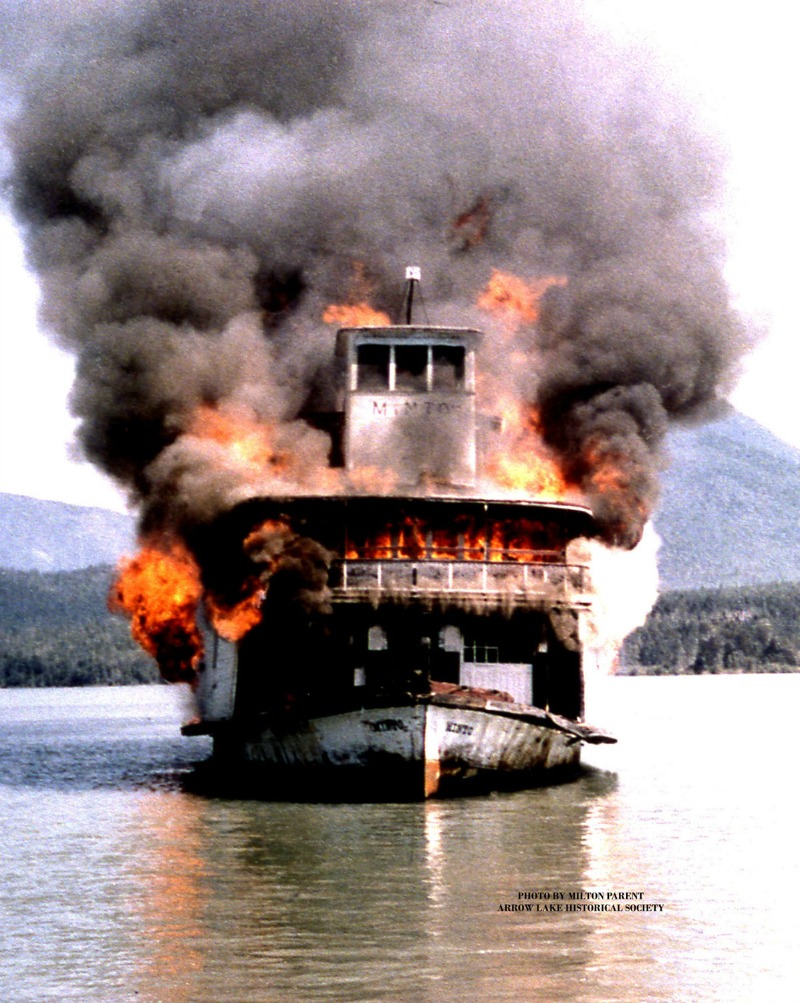
One casualty of the rising waters was the fate of the S.S. Minto. The little sternwheeler was taken from service in 1954 and purchased by the town of Nakusp as a potential draw for tourists. However, the project floundered for lack of funding and leadership and she was sold in 1956 for scrap. Anything of value was removed but just before total demolition, John Nelson purchased her for $800 and towed her to Galena Bay at the north end of Upper Arrow Lake. He lived and worked on the boat to restore her, but his life ended at 88, ten years after beginning the restoration.
BC Hydro assessed the restoration of the boat at over $100,000 so backed away and John’s son, Walter arranged to have the Minto pulled into the middle of the lake for a Viking funeral. She was burned August 1, 1968.
The Minto was a symbol of life on Arrow Lakes that can never be reclaimed. It falls to memory and to organizations like the Arrow Lake Historical Society and OATS to keep the legends from fading.
The Keenlyside and Mica Dams now produce the majority of the electricity used by the interior of our province. The towns along Arrow Lake have the comforts of this utility like the rest of us and pay like the rest of us. The cost we don’t consider is to the environment, fisheries and paradise lost.
From Archivos – magazine of Okanagan Archive Trust Society – editor Brian Wilson