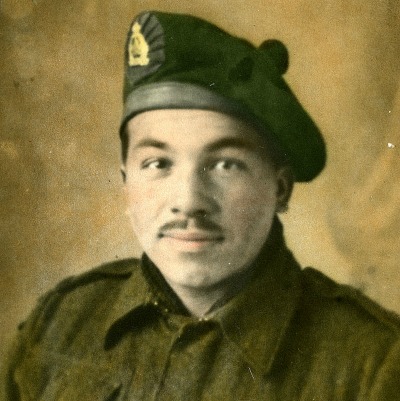
 Henry “Butch” Smitheram
Butch was one of the first in the Similkameen to enlist in the British Columbia Dragoons in 1939. It wasn’t long before his superiors recognized and exploited his talents. He scored the highest for marksmanship in the Canadian Army and was selected for duty in the Special Forces Commandos.
Two years of training in Britain was followed by three years active service at the front, first in Africa then in Europe. He held the rank of Sergeant and was field commander of a tank corp. One of his memorable acts of heroism happened during battle in Europe.
While on reconnaissance in a scout vehicle at the right side of his platoon, he noticed an enemy group advancing undetected from his side. When his attempt to alert his troops by radio failed, he made a dash over 300 yards of heavy enemy fire to warn his troops. He was in time and was credited with saving over 200 of his fellow troopsWhen he returned, he spent a year in recovery in Shaughnessy Hospital where he flirted with many careers but settled in with the Federal Government as Indian Agent in Merritt.
Butch was a proud non-status Indian and was concerned for Native people across Canada . By 1954, he was working on a sensible and economical design for reserve housing. His program was accepted over plans submitted by architects and professional planners for this housing. Tens of thousands of homes were built using his design.
By 1964, Butch was being recognized for his work in voluntary groups concerned with First Nation issues. Under his own initiative, he developed a new concept of Native employability which he called “Reach Out”. His brief soon reached the Federal Cabinet and was expanded to include other employment problems.
This was the basis of Canada Manpower’s “Outreach” program. He was soon moved into the Secretary of States office in Vancouver and for five years he brought his concepts of Native self-help and self-determination to fruition.
In 1972, Butch was transferred to Ottawa to work in the Trudeau Government under the then Minister of Indian and Northern Affairs, Jean Chretien. He found this job prestigious and financially rewarding; but stifling. It was just not his usual challenge.
By 1974 Butch had taken advantage of an opportunity in Kelowna. This put him closer to his hometown and to his family. He turned his focus to the promotion of multiculturalism and the benefits of inter-racial and inter-cultural interaction. He reasoned that promoting and appreciating differences among people in a variegated mosaic would allow the fullest human expression in an individual; instead of discarding them in a homogenized mass. This would create a better society and hopefully world peace.
“The unity of Canada question will not be solved by the Constitution. It will be solved by encouraging people to understand and love one another, and to see each other as Canadians who subscribe to a unique ideology that brings them together as family.”
This single statement says more about the personal philosophy of Henry “Butch” Smitheram than any other. This Order of Canada member spent his life serving the realm of multiculturalism.
Butch took early retirement in 1978 and began working as a voluntary mediator in many BC communities where there was an escalation of racial and sectarian tension. His involvement brought calm and reason where violence was threatened.
He continued with Native economic development in the formation of the Native Construction and Development Corporation, a wholly Native owned company building pipeline projects.
Butch had always been an avid environmentalist and worked as a lobbyist with the Sierra Club in a key role in opposing Uranium Mining and Exploration in the Okanagan.
At the time of his death in 1982, He sat as President of these groups: BC Affiliation of Multicultural Societies, BC Association of Indian Friendship Centres, Interior Indian Friendship Centre,
He was Vice-president of Native Economic Development Corporation and the Northern Native Construction and Development Corporation.
He sat on the boards of the BC Council for the Family, the NDP Constituency Association and the Sierra Club.
Butch Smitheram induced lasting political awareness among BC’s Métis and non-status Indians. He played the major part in founding the Native Council of Canada,
Butch died March 14, 1982 at age 64.
Source: Archivos Magazine, editor Brian Wilson – Okanagan Archive Trust Society