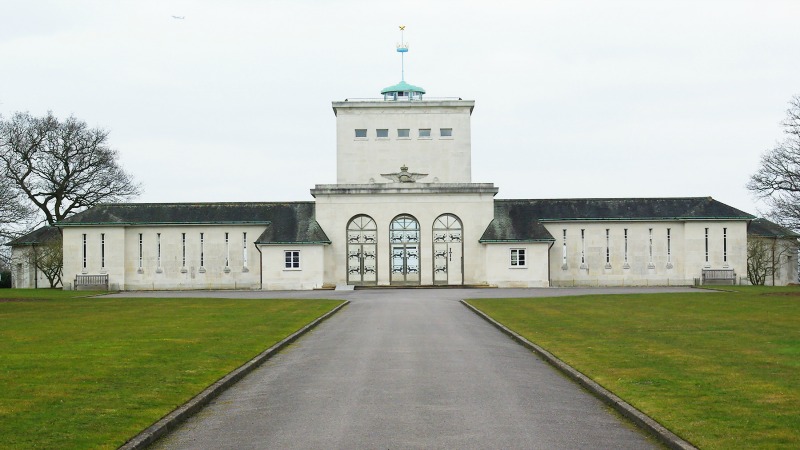
Runnymede Memorial
By Brenda Shaw
Flying Officer Allan Grant Echlin
Grant, as he was known, was born in 1919 in Oliver, B.C. After war was declared, Grant joined the Air Force and was a Flying Officer in the 206th Squadron of the Royal Canadian Air Force.
Grant and his crew flew many sorties leaving from England and flying over France, Belgium, Norway, Sweden, Denmark and the Netherlands. On July 15, 1944 on a bombing run over enemy lines, Flying Officer Grant Echlin’s plane was shot down over the Skagerrrak… Strait. The Skagerrak is a strait running between Norway and the southwest coast of Sweden and the Jutland peninsula of Denmark, connecting the North Sea and the Kattegat sea area, which leads to the Baltic Sea. Echlin’s plane was shot down and his body never recovered, hence the burial at Runnymede.
The Crew that died with Echlin:
Desilets, Forsyth, Gagnon, Johnson, Kozlowski, Linklater, Mackintosh, Magee, Mcclure, Mccollum, Mollard, Omoe, Platana, Pratlett, Scandiffio, Sibbett, Sims, Stroud, Taylor, Taylor
Allan Grant Echlin was the son of Reuben and Lola C. Echlin, of Oliver, British Columbia.
Cemetery:
RUNNYMEDE MEMORIAL
Surrey,United Kingdom
Grave Reference: Panel 246.
Location:
During the Second World War more than 116,000 men and women of the Air Forces of the British Commonwealth gave their lives in service. More than 17,000 of these were members of the Royal Canadian Air Force, or Canadians serving with the Royal Air Force. Approximately one-third of all who died have no known grave. Of these, 20,450 are commemorated by name on the Runnymede Memorial, which is situated at Englefield Green, near Egham, 32 kilometres by road west of London.
The design of the Runnymede Memorial is original and striking. On the crest of Cooper’s Hill, overlooking the Thames, a square tower dominates a cloister, in the centre of which rests the Stone of Remembrance. The cloistered walks terminate in two lookouts, one facing towards Windsor, and the other towards London Airport at Heathrow. The names of the dead are inscribed on the stone reveals of the narrow windows in the cloisters and the lookouts. They include those of 3,050 Canadian airmen.
Above the three-arched entrance to the cloister is a great stone eagle with the Royal Air Force motto, “Per Ardua ad Astra”. On each side is the inscription:
IN THIS CLOISTER ARE RECORDED THE NAMES OF TWENTY THOUSAND AIRMEN WHO HAVE NO KNOWN GRAVE. THEY DIED FOR FREEDOM IN RAID AND SORTIE OVER THE BRITISH ISLES AND THE LANDS AND SEAS OF NORTHERN AND WESTERN EUROPE