From: Devon Wannop, CFO
To: Council
RCMP Costing Analysis
RATIONALE:
As part of the strategic plan it was determined that the Town of Oliver should determine the costs of going over 5,000 population and being responsible for 70% of the policing costs (most likely in 2022 which is the next federal census).
RECOMMENDATION:
That Council accepts the report for information and to bring the the additional costs associated with RCMP through the budgetary process.
General:
Organizational:
Financial:
If the Town of Oliver passes the 5,000 people population it would mean that we would have the pay 70% of the total RCMP costs for our area plus the infrastructure and capital purchases. This is a significant increase from what we are paying now. Since we are currently under the 5,000 people threshold we only pay 30% of the RCMP costs. This significant increase has been estimated at approximately $600,000.
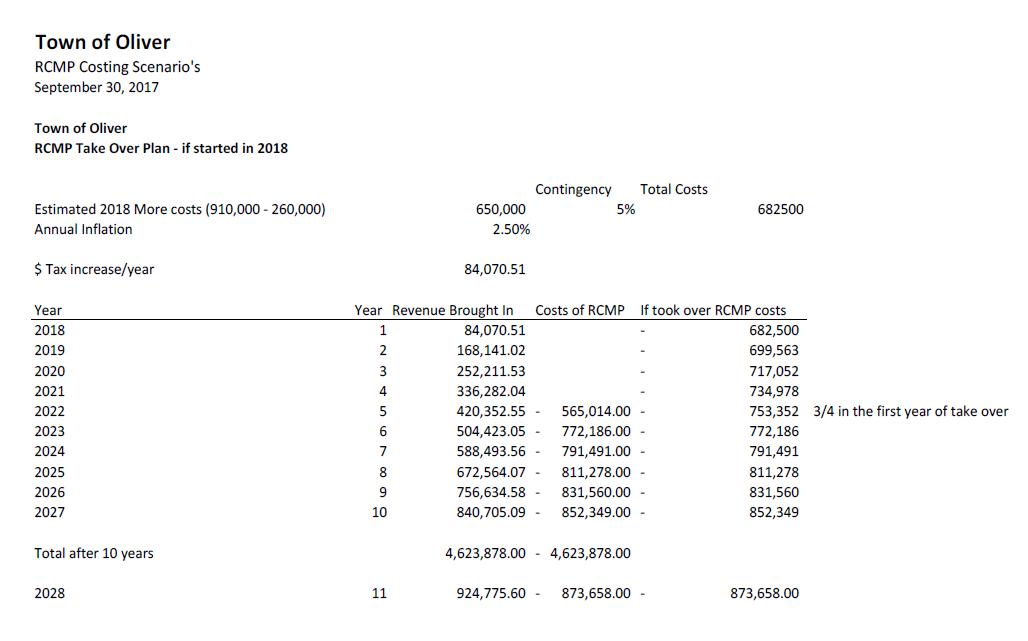
I have provided analysis of many different scenarios of when we would start to save for the upcoming costs.
Legal/Statutory Authority:
Strategic Plan:
Policing
BACKGROUND:
Under the BC Police Act a municipality must assume responsibility for its police services when, as a result of a Canada Census, its population exceeds 5,000 persons.
These municipalities may form their own independent municipal police department, contract with an existing independent municipal police department, or contract with the provincial government for RCMP municipal police services. As you will see from the attached information I have provided 4 different scenarios of funding models of when we would start to save for the foreseen costs associated with the current RCMP costing model. You will see that if we start to put money into reserves in 2018 it will be a steady increase (and lower) than if we start any other year. Also with this funding model the taxpayers will not have to fully pay for the costs associated with policing until the year 2028 even though we would start paying a higher share in 2022. In this analysis I have made the assumption that the annual inflation will be 2.5% every year and I included a 5% contingency for expected expenses (such as a major crime that would have significant costs). The differential costs have been provided by municipalities that are our approximate size and location.
The basis of this example is that we as the municipality would want to increase the revenue that we bring in every year by the same amount to have a consistent and steady increase. For example in the 2018 funding model the revenue we generate in per year is 84,070.51 more than we generated the previous year. For this models purpose you are trying to figure out the number of years that you can have the steady increase before you are funding the full costs of the RCMP or more. Meaning that your revenue will always be less than the costs until the final year, and in the final year you can stop with the steady increases and increase it based on associated costs.