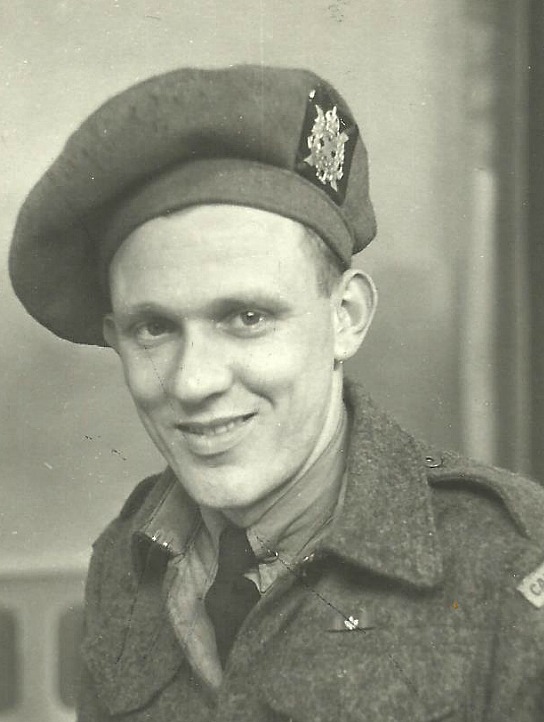
Eric Shannon was born in 1921. His mother died when he was nine years old and he lived with his father and three brothers in the Mt. Pleasant neighbourhood of East Vancouver. His father was a building contractor but there was not much work and very little money available. However, they were in the same situation as most other families. There were many children in their neighbourhood, so there was always lots of activity for the Shannon boys. In 1939 Eric rode a bicycle to Oliver where Bob, an older brother was teaching school. The bicycle did have hand brakes but it did not have coaster brakes (when the rear wheel was turning so were the pedals). Eric had steel caps attached to the toes of his shoes which he would drag on the ground when he wanted to slow down. This bicycle is still in the family. The Hope-Princeton Highway was not built at this time so he had to ride through Spences Bridge and Merritt, south to Princeton and east to Oliver. Eric found a job working for Alan MacDonald, on an orchard north of Oliver. Alan was a bachelor and when he realized Eric knew how to play bridge, Alan took advantage of the situation. Alan let it be known they were available to play bridge with other couples, and this usually lead to a dinner invitation as well. One evening Alan and Eric were invited for dinner and bridge by George and Phyllis Curbishley, neighbouring orchardists in the West Lateral neighborhood, and it was here that he first met his future wife Elaine, their seventeen year old daughter.
On Nov. 3, 1939 while back in Vancouver, Eric joined the Merchant Marine. Family lore has it that it did this on a dare. The first ship he sailed on was the M.V. Trevalgan. On one voyage Eric contracted malaria and had a high fever for several weeks. Eric said that the skipper later told him that he did not expect Eric to survive. On another trip when his freighter was loading cargo in Kingston, Jamaica, Eric was working alongside a local longshoreman. Apparently Eric made a comment to the longshoreman about the way the he was doing his job, which the longshoreman did not like. He pulled a knife and attacked Eric. It happened very quickly and it ended with the longshoreman in the harbour. Eric said it could very easily have ended badly for him. On one occasion when his freighter was in Liverpool and Eric was on shore, in a building (possibly a pub), there was a German air raid. A large bomb landed on the street very close to the building he was in, but it did not detonate. Eric realized that if the bomb had exploded there was a very good chance he would have been killed. On May 20, 1941 he was on the S.S. Cockaponset, in a convoy that was attacked by German submarines. Eric said that when the oil tankers were hit they went up in flames very quickly. The crew on those boats had a small chance of survival. The Cockaponset was loaded with 225 tons of TNT among other types of cargo, but the inside of the hull was lined with thick bags of some kind of “carbon black” powder which protected the explosive freight from the torpedoes. In any event, Eric’s ship was hit with a torpedo and sunk. All forty-one men on board the Cockaponset made it into two lifeboats and they were picked up by the rescue ship, the “Hontestroom” and taken to Reykjavik, Iceland. Eric was then transported to Glasgow on another boat which was attacked by German aircraft on June 2, 1941. This ship was hit and had its pumps going full speed just trying to stay afloat. During this attack, Eric was shot multiple times in the left leg by a German aircraft that was strafing the ship. With help from some deep-sea tugs that came out from Glasgow, this ship did make it into the port. Eric said the port community must have been aware of them because as the tugs helped their ship up the river Clyde to its berth, the other ships in the Port blew their whistles and the crews on board and the longshoremen working on the river cheered for them. It was apparently a very moving experience. Eric spent several months in two Glasgow hospitals recovering and became good friends with the extended family of one of the hospital staff, whom he always referred as “Ma Wylie”. He maintained contact with this family for the rest of his life.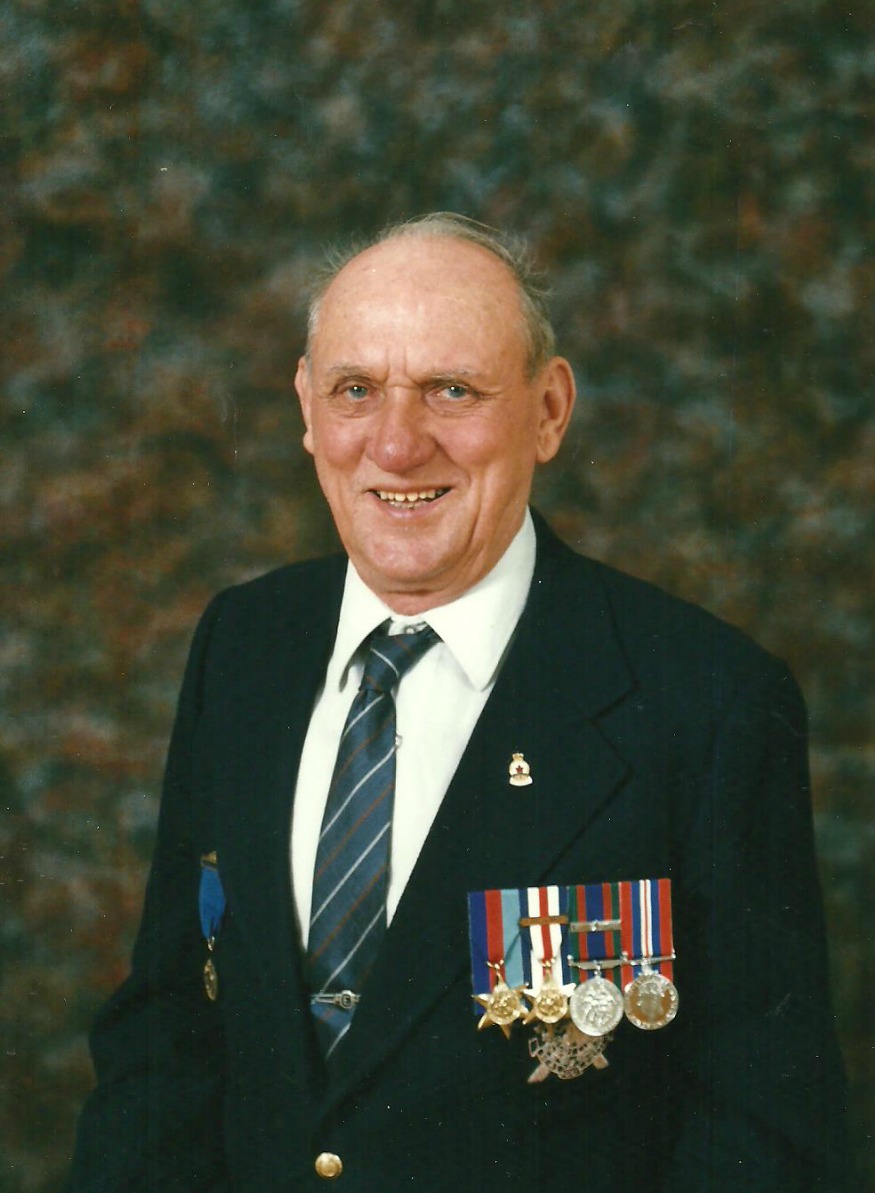
Eric sailed around the globe in the Canadian, British, Dutch and possibly other Merchant Marine fleets, with many adventures and misadventures. The last ship Eric served on was the “Blommersdyk”, which was owned by the Holland America Line. He served on this ship from April 7, 1942 to Oct. 31, 1942. He left this ship in New York with the intention of returning to Vancouver by bus. This was an eventful trip because there were severe snowstorms on the East Coast and Mid-West of North America. He ended up travelling through Houston, Texas. The story of a Canadian sailor travelling from New York to Vancouver via Houston did not seem plausible to American authorities in Houston. Eric maintained that the immigration service in New York did not return all his identity papers to him. Eric was placed in a jail with a large number of Mexicans, as an illegal immigrant, until he could present his case at a formal hearing. This was eventually straightened out and he arrived back in Vancouver just before Christmas.
Eric enlisted in the Canadian Army on June 7th 1943. He received his training in Vernon B.C. and Dundurn Sask. and was shipped to England in March 31, 1944. His regiment, the Canadian Scottish was stationed at Aldershot and the young soldiers waited there for the invasion to begin. The Canadian Scottish Regiment was part of the 7th Brigade, in the Canadian Army’s 3rd Infantry Division. The Regina Rifles and the Royal Winnipeg Rifles were also in the 7th Brigade. The Canadian Scottish had six Companies (A, B, C, D, Support and Headquarters). The first four were referred to as Able, Baker, Charlie and Dog Companies. Each company had three platoons and the platoons were divided into sections. Eric was assigned to C Company.
By early June of 1944, the Canadian soldiers suspected the invasion was imminent. Some of them had been waiting and training in England for three years. Eric crossed the channel, a few days after D-Day
Eric survived while many did not. It was tough going. The following quote is taken from page 269 of “Ready For The Fray The History of the Canadian Scottish Regiment 1920 To 1955” by R.H. Roy. The situation described in this quote was near Caen, one and one half months and three major battles after the D Day invasion. Note that soldiers were already being described as “old timers”.
“… This shelling and bombing caused a constant trickle of casualties. Men were hit as they ate, slept or went from one place to another. Reinforcements coming to the battalion were sometimes killed or wounded before they even reached the company to which they were being posted. The “old timers” were cut down in ones or twos every day. The initials “PBC” (Psychiatric Battle Casualty) appearing after a man’s name on the casualty list, if not common was no longer unique.”
Eric told a friend about one event that occurred around this time. Eric and two other soldiers were having a (smoke?) break, in what they thought was a relatively safe location, when German snipers shot the men on either of Eric. He was not injured.
Eric participated in many major battles in 1944 – 1945. These include Caen, Calais, Falaise, the Scheldt River estuary and Leopold Canal, the Breskens Pocket, and the Rhineland. Eric was officially wounded twice, on Oct. 13, 1944 and April 21, 1945.
One story Eric told was of capturing a German soldier (he basically surrendered). This prisoner had lived in Vancouver before the War and spoke English. Eric turned him in to an officer, who took him back Brigade headquarters, where the prisoner willingly disclosed useful information on German defensive positions. The officer later told Eric that he received a medal as a direct result of the information this prisoner disclosed. This is similar to an incident described on page 258 of “Ready For The Fray”. I do not think it was the same event though.
Eric was impressed with the immense gratitude and happiness shown by the Dutch, as their towns and country were liberated by the Canadians.
The following is a quote from page 339 of “Ready For The Fray”. I suspect it is typical of the experience of many young Canadian soldiers. This particular battle involved advancing over a large dyke of the Leopold Canal. The Canadians were on one side and the Germans on the other. Note that a platoon at full strength had 45 men plus an officer.
“Two hours before midnight, therefore, after a mortar and artillery barrage, the two companies went over the top, scrambling to take advantage of their own “grenade barrage” at H hour. The men fought their way forward for a distance of about 50 yards, overrunning many enemy positions on the way. “C” Company like all the other companies was considerably under strength owing to casualties, but even so this company alone took about 65 prisoners during the attack. No. 13 platoon, commanded by Sgt. Byron, captured about 30 prisoners although there were only 14 men in the entire platoon. Shortly after this engagement the company commander wrote:
“Men who were particularly outstanding in this show were Cpl. A. Palmer who took command when Sgt. Byron was wounded, Pte. P. Coleman… who took charge of a section and did very good work in clearing out the Germans from the dyke, and Pte. E.G. Shannon who carried on until the fight was over despite being wounded in both arms. These are men who were mentioned to me, but there were many more and every man did an excellent job.”
Not all the battles were successful though. The Canadian Scottish Regiment was in a very tough battle at Heseler Field / Moyland Wood, in Germany and C Company was pinned in a very uncomfortable position. On Feb. 19th 1945 they were ordered to attack a well-defended German position. C Company at that time consisted of three under strength platoons, a major, two lieutenants, a company sergeant major, two sergeants, seven corporals and approximately 55 infantrymen. Many of the battle-wise Canadians, including Eric, knew it was a hopeless task, but orders were orders. The attack proceeded and it was a complete disaster. Only seven members of C Company escaped. Eric was one of them. The remainder were either killed or captured. This battle has been documented several times. Ralph Pearcey wrote an article titled, “Ordered In” that was published in the January/February 1997 issue of the Legion Magazine. Mr. Pearcey was a new lieutenant assigned to C Company and this was his first action. He was taken prisoner and spent the rest of the War in as a P.O.W. In this article he describes the complete hopelessness of the situation. This battle is described as follows, on page 382-383 in “Ready For The Fray”
“The entire action from the time the company crossed the start-line until it was surrounded and either shot up or captured, lasted little more than an hour. It was a terrible blow to the battalion, one which it half expected from the outset since the task set for the unit ….. meant that almost every principle of war had to be ignored… It is little wonder that Heseler Field was nicknamed Slaughter Hill by the men in the Canadian Scottish.”
Immediately after this battle Eric went back on his own, to join up with some support troops behind the front line. Several days later, when Eric rejoined his regiment, he was told he had been reported as killed in action. Eric had become a buddy of A/Cpl. Percy Coleman and often fought beside him. Eric had written a letter to Elaine Curbishley, who was living in Oliver. This letter was given to Percy Coleman, to mail, if Eric was killed in action. Eric was fighting beside Percy in this battle when Percy was killed. When the bodies were recovered, they found the letter from Eric, on Percy’s body, and assumed it was Eric that had been killed. The officials were able to stop the telegraph before it was sent back to Vancouver. C Company had been eliminated and A, B & D companies were very beat-up. On Feb. 22nd, the Brigadier in command of this operation left the field, to command a training brigade in the United Kingdom. The Royal Winnipeg Rifles were brought in to help the Canadian Scottish and with extensive artillery and air support (something the Canadian Scottish should have had) they were able clear out the strongly held enemy positions.
Near the end of the War, Eric was transferred to Headquarters Company, given a Harley Davidson motorcycle, and told that he was courier. I remember him telling two stories about this particular assignment. One related to being stuck in terrible mud and the other was when he unknowingly rode into a German position. When the soldiers in from of him began shooting, he was able to turn around and make a very hasty retreat. Eric knew had been very lucky to escape alive. I don’t think Eric ever road a motorcycle after the War.
There was a constant turnover in the Company. Men were being killed or seriously wounded in action, and replacements were arriving. These types of experiences are hard to ignore and they must have had short and long term effects on many young men.
I remember as a teenager, complaining to my Dad that “All my friend’s fathers take them hunting, why won’t you take me hunting? He replied, “I did enough shooting during the War, I don’t ever want to shoot a gun again.” Needless to say that was the end of that conversation. A friend of Eric’s, many years later, said that Eric was a fatalist. Eric had told him that he never worried about dying, because when your time is up, there is nothing you can do about it. Eric probably realized that he had been very lucky to live as long as he had.
Eric was discharged on Aug. 8, 1945. After spending time in Vancouver, Eric returned to Oliver where he purchased some land through the V.L.A., built a house and married Elaine in 1948. Eric planted an orchard in 1949 but continued working out, first as a carpenter, then as a surveyor with the Ministry of Highways and the Southern Okanagan Lands Project, in the straightening of the Okanagan River channel. In 1959 Eric purchased a second orchard and became a full time orchardist. In 1964 He purchased a third orchard. The orchards he purchased were from retiring pioneer orchardists, the Boones and the Deightons, who became good family friends. During these years Eric and Elaine raised a family of four children, Larry, Patti, Gordon and Norman.
Eric was active in the community, including serving a term as President of Oliver Branch 97, of the Royal Canadian Legion in 1956. Eric learned how to play bridge as a child and Elaine was also a bridge player. They enjoyed playing social bridge, for most of their lives. When the orchards allowed and the family was older, Eric and Elaine enjoyed travelling with friends, in their trucks and campers. Eric and Elaine also made trips to Europe and Asia. He maintained friendships with many of his Can. Scot. buddies, and regularly attended Canadian Scottish Regimental reunions. Eric and Elaine travelled to France for the 40th anniversary of D Day celebrations in 1984, with other Canadian Scottish veterans. Eric passed away peacefully, in 1996. Elaine is still living in Oliver.
Pictures and story supplied by the Shannon Family