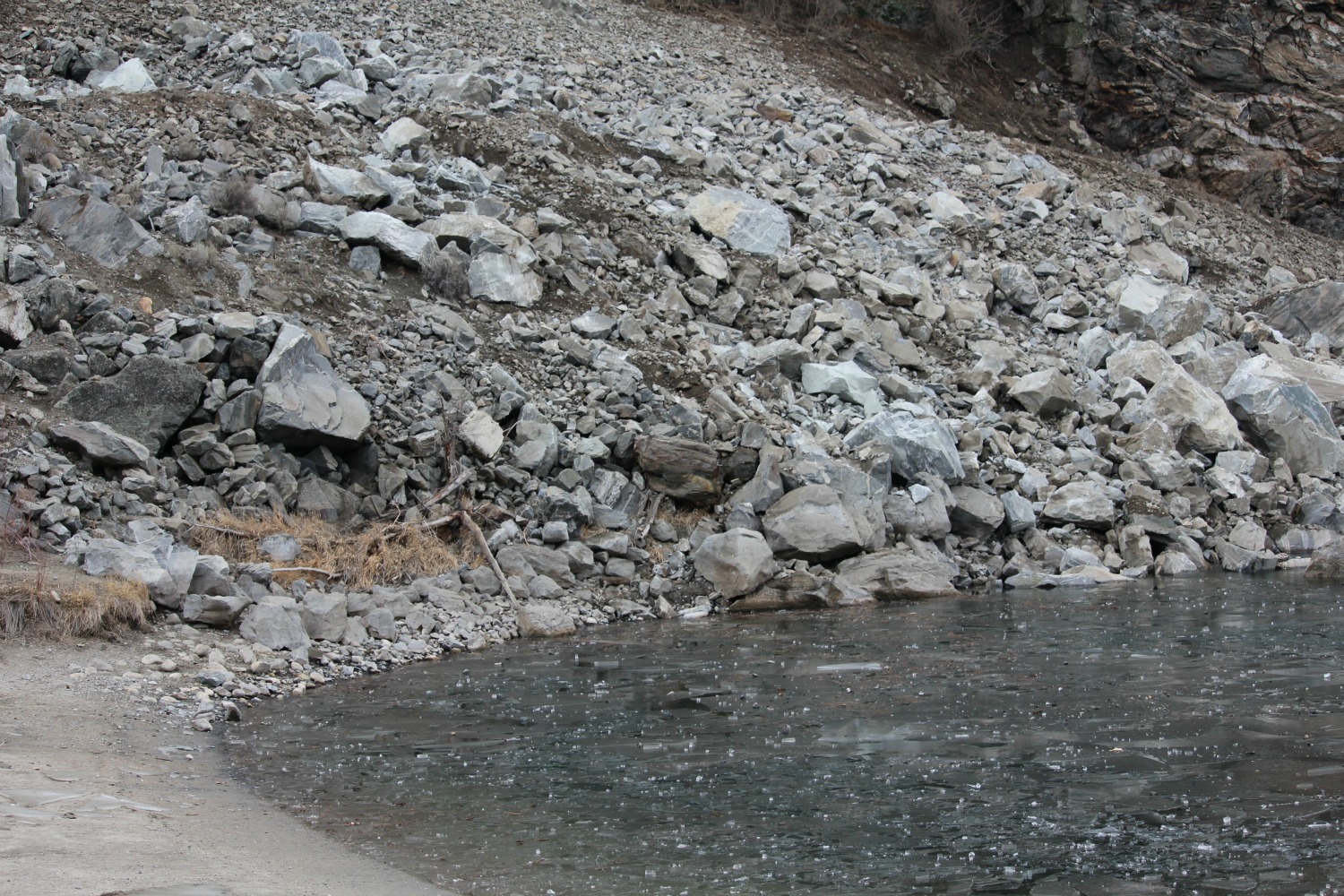
Siphon repair will cost millions
Preliminary estimates put the potential cost to permanently repair the Gallagher Lake siphon at between $4.5 million and $9.5 million.
In a report to council on Monday, acting Chief Operating Officer Tom Szalay outlined a series of potential fixes as proposed by the town’s engineering consultants True Consulting.
Szalay emphasized that the prices attached to the options are just “order of magnitude estimates” and the actual cost of each could be substantially higher or lower.
Council agreed to pay True Consulting $30,000 to further explore and better define the options and their costs.
The Gallagher Lake siphon is a section of the Oliver area irrigation system. It was severely damaged by a rockslide in January. The town has spent nearly $500,000 on a temporary fix that enabled the provision of irrigation to agriculturalists in the valley.
The options outlined in the True report range from repairing the existing siphon in place to tunneling through the mountain adjacent to Gallagher Lake.
Option 1. Repair existing siphon. Estimate $4.5 million.
This would involve removing the existing pipe and replacing it with a new one. In the interim, a temporary pumping station and pipe would be installed around the current site.
Advantages include no need for a new right of way, no loss in water capacity and possibly lower costs than other options. Some of the disadvantages include unknown costs of scaling rock above the site and high costs of temporary pump and pipe.
Option 2. Re-route siphon around the lake. Estimate $9.5 million.
This option would see a new siphon running along Highway 97 and hooking back into the existing system south of Gallagher Lake.
The advantages include no rock-scaling costs, a conventional approach and minimal risks in the future. The disadvantages include the need to acquire right of way and permission of the provincial Ministry of Transport. Also, the anticipated costs are high.
Option 3. Tunnel through mountain. Estimate $8.3 million.
This option would involve drilling or blasting a tunnel through the mountain east of Gallagher Lake.
The advantages include limited or zero scaling costs, no loss of water capacity and predictable costs. Disadvantages include the need to acquire various rights of way and high potential costs.
Option 4. New pump station at Kiwanis Park. Estimate $5 million.
This option was dismissed by council and will not be explored.
Option 5. New siphon at Gallagher Lake. Estimate $5 million.
A new, twin plastic siphon would be run across the floor of the lake, tying in to the existing system at the north and south ends of the lake. This would eliminate the danger of rock falls damaging the system.
Advantages include possible lower costs and a minimal loss in water capacity. Disadvantages include the need to acquire rights of way from the Osoyoos Indian Band and a private landowner. Ministry of the Environment approval would also be needed.
Extra option. Repair in place. Cost unknown.
One extra option was suggested by Water Councillor Rick Machial. It would involve repairing the existing siphon underground, without removing the backfill that covers the installation.
Council decided Option 4 would be eliminated and the suggestion of Councillor Machial added in place.
Machial suggested the option would be cheaper than any of the others. Operations director Shawn Goodsell said that Worksafe BC might well declare such an operation too dangerous.
The timeline in Szalay’s report would see:
• Choosing of the preferred option by November 2016
• Final design, budgeting and permitting completed by March 2017
• Tendering completed by summer 2017
• Construction beginning in August or September 2017
• Completion target in April 2018
Funding for the project remains up in the air. The town will apply for grants from both senior levels of government, possibly including the Canada 150 Program, said Mayor Ron Hovanes on Monday.
As well, members of council will begin lobbying provincial ministers, including agriculture and finance, at next month’s Union of BC Municipalities convention in Victoria.
The Oliver irrigation system begins at McIntyre Dam, goes past Gallagher Lake, across the OIB lands and ends near the north end of Osoyoos Lake. The temporary fix proved adequate to meet the water needs of vintners, orchardists and others this summer, partly because of the relatively cool temperatures. Goodsell said, however, if next summer is as hot as 2015, it could be “touch and go.”
Reporter Roy Wood