The Osprey
by M B Lancaster
The Osprey may be found almost anywhere in the world although this may in some cases be due to wintering birds rather than breeding birds as it is of course migratory. Divided into two species; Western Osprey and Eastern Osprey, the latter occurs only in SE Asia and Australia as a single nominate species whereas the Western Osprey has three subspecies, that in Canada being carolinesis.
This year for the second time only in 16 years, the breeding platform on the Forbes property was occupied. On the previous occasion a rather desultory effort was made and I put that down to being an immature pair ‘practising’ This year very determined efforts were made to breed having established a territory. The male arrived first and started carrying sticks to build the nest. At this stage I observed a piece of behaviour I had not seen before, he was swooping down and carrying off sods from the recently turned surface of the cultivated fields on the west side of the dyke. I was unable to find any reference to this in either Birds of North America (BNA online subscription) or Birds of the Western Palearctic ( software edition) but both mentioned grass and small twigs being used to line the nest but this hardly applied as there was as yet no nest. I came to the conclusion that the sods were being used as a base around which sticks would be arranged – thus less likely to be blown off the flat surface before sufficient weight of material would hold the nest in place. Another piece of behaviour new to me was the sight of a bird flying at a dead tree and snapping off a stick whilst in flight – quite spectacular.
Soon after the arrival of the male, there were three birds at the nest (possibly four) two males attempting to deposit sods and one female harassing one of the males. I am not sure if the original male was deposed by a pair or not. Nest building was completed, eggs laid, incubated, and at least one chick hatched. This appeared to be a runt of a bird when it was large enough to be seen and in fact died and the pair then sat around for a day or two and now only visit occasionally. One person did tell me they had seen three young. Better luck next year?
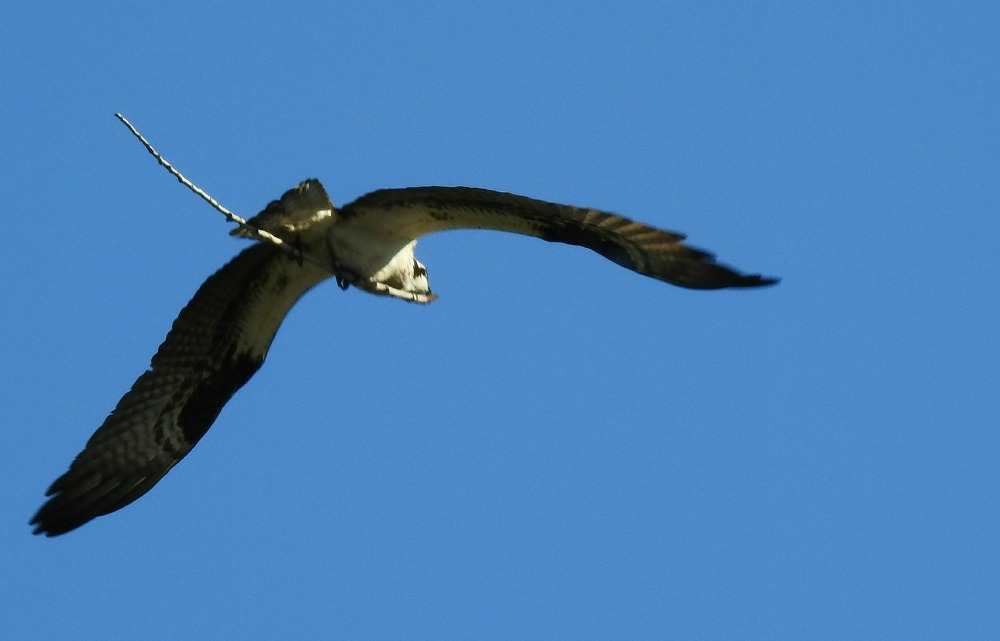
Males which are smaller than females ( a trait of most hawks) are less likely to have any spotting on the breast than the female so with close observation sexes can with luck be distinguished in the field. Other habits useful for distinguishing are that usually only the female incubates at night and that whilst nest building males carry longer sticks than females and I suspect that it was the male that was breaking sticks from the dead tree where the Lewis’s Woodpeckers bred – I never got good views to confirm this suspicion.
I did however get a ‘snatch shot’ of a flying male with a very long stick. Note lack of spotting and the way the bird is holding the stick as it would a fish – aerodynamics.
Nikon P900 400th sec@f6.3. Michael Barry Lancaster
Osprey – Postscript
Although I walk the dyke most mornings, for at least 10 days, possibly 14, I have seen no evidence of offspring at the Osprey nest. Neither visually or parent feeding a hidden youngster. Indeed any evidence of any Osprey was absent most mornings. This morning (1st) I was pleasantly surprised when an adult ( fish-less) landed on the nest side and momentarily a quite well feathered youngster appeared, flapped its wings and promptly disappeared.
The most likely explanations for my lack of observations are a) in the absence of siblings, a sole offspring does not need to make its presence obvious in order to be fed b) one offspring needs less visiting c) at this age it can probably feed itself. None the less, I do feel it is a small bird – possibly a male.