School District No. 53 (Okanagan Similkameen) June 24, 2016
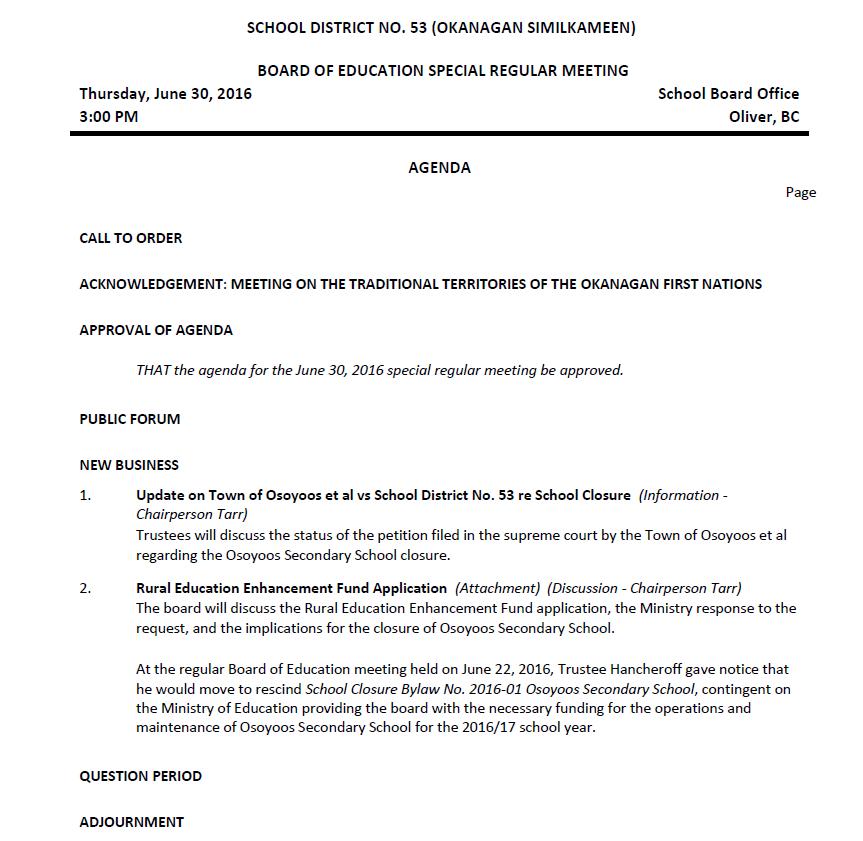
Rural Education Enhancement Fund Application
1) School District name and key contact:
School District #53 (Okanagan Similkameen)
Box 1770 6161 Okanagan Street
Oliver BC V0H 1T0
Lynda Minnabarriet, Secretary Treasurer
2) School for which funds are being requested:
Osoyoos Secondary School
5800 – 115 Street
Osoyoos BC V0H 1V0
3) Overview of local community context:
Osoyoos Secondary School (OSS) is a Grades 8-12 school located in the town of Osoyoos. The Board has
held numerous meetings with communities and stakeholders since 2009 highlighting its challenges with
declining enrolment, budget reductions and aging facilities. In January 2016, the board released the 2015 Facilities Plan and approved a school closure consultation process to consider the following two recommendations:
a. closure of OSS and transfer Grades 8-12 students to Southern Okanagan Secondary School (SOSS) in
Oliver; or
b. closure of Osoyoos Elementary (OSE) , renovate Osoyoos Secondary to a K-9 facility and transfer
Grades 10-12 to Southern Okanagan Secondary in Oliver
The Board held the school closure consultation process from mid-January to April 2016 and passed a
School Closure Bylaw for Osoyoos Secondary School on April 27, 2016.
4) Overview of school district and school context:
SD 53 is a rural district with schools in the communities of Cawston, Keremeos, Okanagan Falls, Oliver,
and Osoyoos with a total school enrollment of 2,160 students as of October 2, 2015. The district also has
a distributed learning program (YouLearn) with an FTE of 60 students as of October 2, 2015. In 2005, student enrollment in school facilities (excluding YouLearn) was 2,809. Since 2005, enrollment in school
facilities has declined by 650 students or 23% (decline at OSS has been 28% in the same time period). A
further loss of 250 students is expected over the next eight years, with school facility enrollment
projected at 1,910 students in 2024-25. Student capacity across the district is 2,900 seats and the district
projects there will be 820 seats available in 2017 and 990 seats available in 2024.
The district has an 2015/16 operating budget of approximately $24m and a current structural deficit of
$500k. Existing surplus was used in 2014/15 and 2015/16 to offset this structural deficit, however, the
Board did not wish to continue to offset the structural deficit in future years. Preliminary projections showed an anticipated deficit for 2016/17 of $1.1m. In addition, the operating structural deficit projected for 2017/18 was $1.4m. With the OSS school closure savings and numerous other reductions, the board anticipated using approximately $100k of surplus for 2016/17.
OSS has a 2015-16 enrollment of 230 students. Projected enrollment for September 2016 is 225 students
and September 2024 projection is for 203 students. The student capacity is 325 students. The school is
currently at 71% of capacity and is projected to be at 62% in 2024-25. Student headcount in cohort grades
are projected to be small in the foreseeable future due to declining enrollment. This impacts the
recruitment of specialized teachers, course offerings and compounds timetable constraints even with
innovative structures. The FCI rating for the school is .40, rated as poor and requires mechanical, electrical, structural and plumbing upgrades with potential capital costs of $4.8m over the next five years (as identified in CAMS).
5) Why the school is at risk of being closed:
Declining enrollment, a structural deficit, small student cohorts effecting course offerings, and a poor
facility rating are the rationale for closing the school. The district’s understanding is that available student capacity throughout the district impacts the board’s ability to receive capital funds for upgrades.
Many concerns were raised during the school closure consultation process such as impact on students
and on the community. Concerns include:
Students going to school outside their home community;
Student time lost due to bus travel; Transportation issues for students with unique needs;
Impact on extra-curricular activities; Fear of bullying and student discipline issues resulting from combining student populations; Negative impact on the economy of the town; Negative impact on the local housing market; Negative impact on after school employment of students.
6) Expected savings from school closure:
Salaries and benefits $207,800
Supplies and services 82,500
Utilities 57,000
Grounds and maintenance 40,000
Total operating savings $387,300
Additional costs to ensure OSS is open, in compliance with legal requirements, and provides a safe environment for students and staff:
If OSS was not facing closure this year, the district would have budgeted the following dollars:
$50,000 for domestic hot water tank replacement as it is at the end of its useful life (2012);
$30,000 for replacement of flooring in two classrooms (no longer able to weld vinyl seams);
$10,000 for scheduled gym floor resurfacing;
$7,000 for exterior lighting upgrade scheduled for all schools this year;
$6,500 for asbestos inventory as required by WorkSafe BC.
7) Identification of schools within the area that have capacity to receive students:
SOSS has a capacity of 700 students and a projected enrollment of 450 students for 2016-17 and is able to accommodate the students from OSS. The school required a minor renovation to convert an open space
into two classrooms in anticipation of the additional students from OSS. The new anticipated capacity of
SOSS is 750 with these renovations. The distance between the towns of Osoyoos and Oliver is 20.8 kms