For the Birds: They’re all here
I am sure even the most casual birder has noticed that these days the air is full of bird song, fledgling chicks are running around and attempting to fly with varying degrees of success. It’s obviously because we are in the midst of prime breeding season. For our resident birds, this season may be nearing completion. For some of our late arriving migrants, the process may still be at the beginning stage.
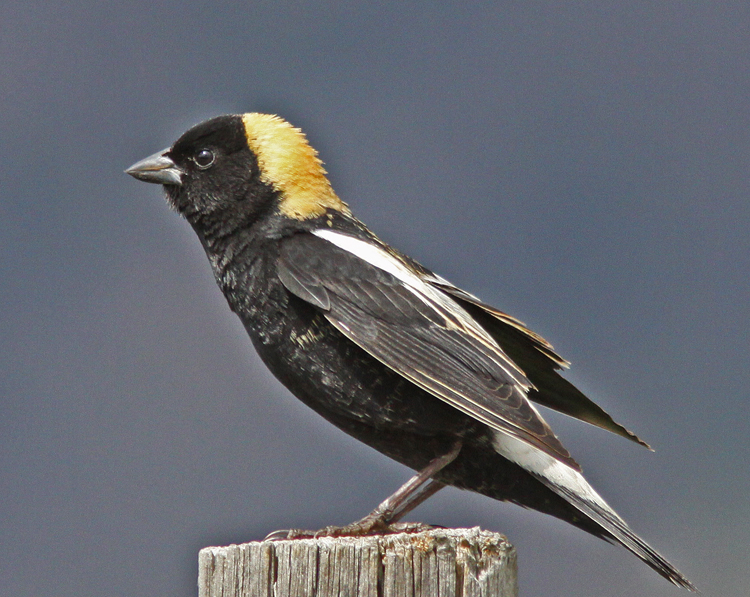
For regular readers of ODN, they may have noticed the recent announcement of Nature Conservancy Canada’s recent efforts to acquire more land on the north side of Rd 22 heading towards Osoyoos. This is such critical habitat for a variety of animals, not the least of which is a bird that has the longest migration path of any songbird in North America. I am speaking of course of the rather oddly coloured Bobolink, a small blackbird that spends the summer with us, and then flies as far south as the Pampas region of Argentina in the winter. It likes the tall grass that typically grows in the Rd 22 area of our region. Historically this grass would be cut for hay which was bad news for this bird, as nests would often be destroyed in the process. With both sides of Rd 22 being protected the preferred habitat for this bird will now be in intact. If you drive along Rd. 22 presently the birds seem to be most easily seen on the north side. A section of this ground has had its grass cut, and the birds can be seen along the edge of the cut area. Look for a mostly black bird with a distinctive yellowish cap on its nape and the back of its head. By protecting nesting habitat at our end, we are providing an enormous “ leg up “ for this bird as its habitat on its winter grounds is under increasing threat, and overall the numbers for this species are trending downwards.
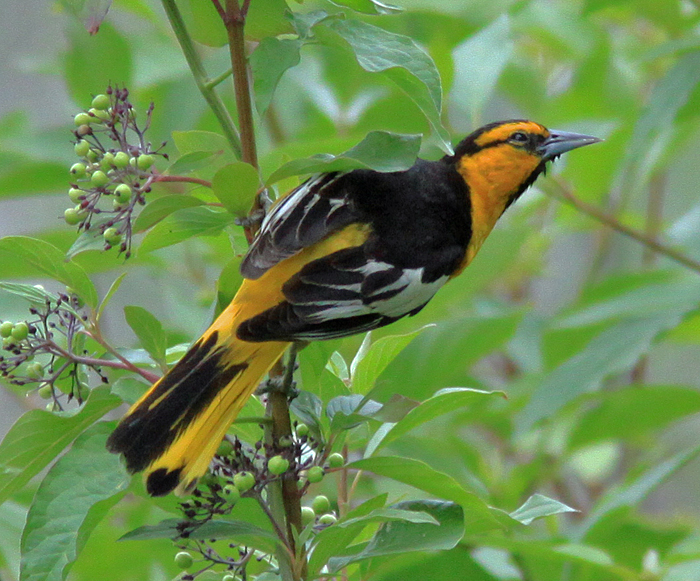
At the Desert Center, ( a non-profit operation run by the Osoyoos Desert Society , and located west of highway 97 north of Osoyoos, ), we are seeing a number of birds establishing breeding sites very close to the center’s buildings. There are a number of bluebird boxes erected around the property. Not surprisingly, some are occupied by other species and all can be easily seen. Currently there is a family of Tree Swallows, House Wrens, and, of course, Western Bluebirds occupying the boxes. A pair of Killdeer nested on the gravelly forefront near the boardwalk, producing 4 eggs which have all successfully hatched. In the nearest elm tree to the center a pair of the very colourful Bullock’s Oriole have built a nest, and they often “ bathe “ in the water in the adjacent Spadefoot pond, a great photo op. A pair of American Robins has built a nest underneath the water storage tanks at the back of the building. The hummingbird feeders are attracting mostly Rufous Hummingbirds, but Calliope, ( the smallest hummingbird in North America ), are also coming in. Lots of action going on!
In this season of new life, it is worthwhile to take a few minutes and appreciate the wonders of nature that surround us. As usual, if readers have any bird related questions, they are welcome to contact me at thormanson@live.com.
Good birding.