With credits to “The Big Break” by Oliver News
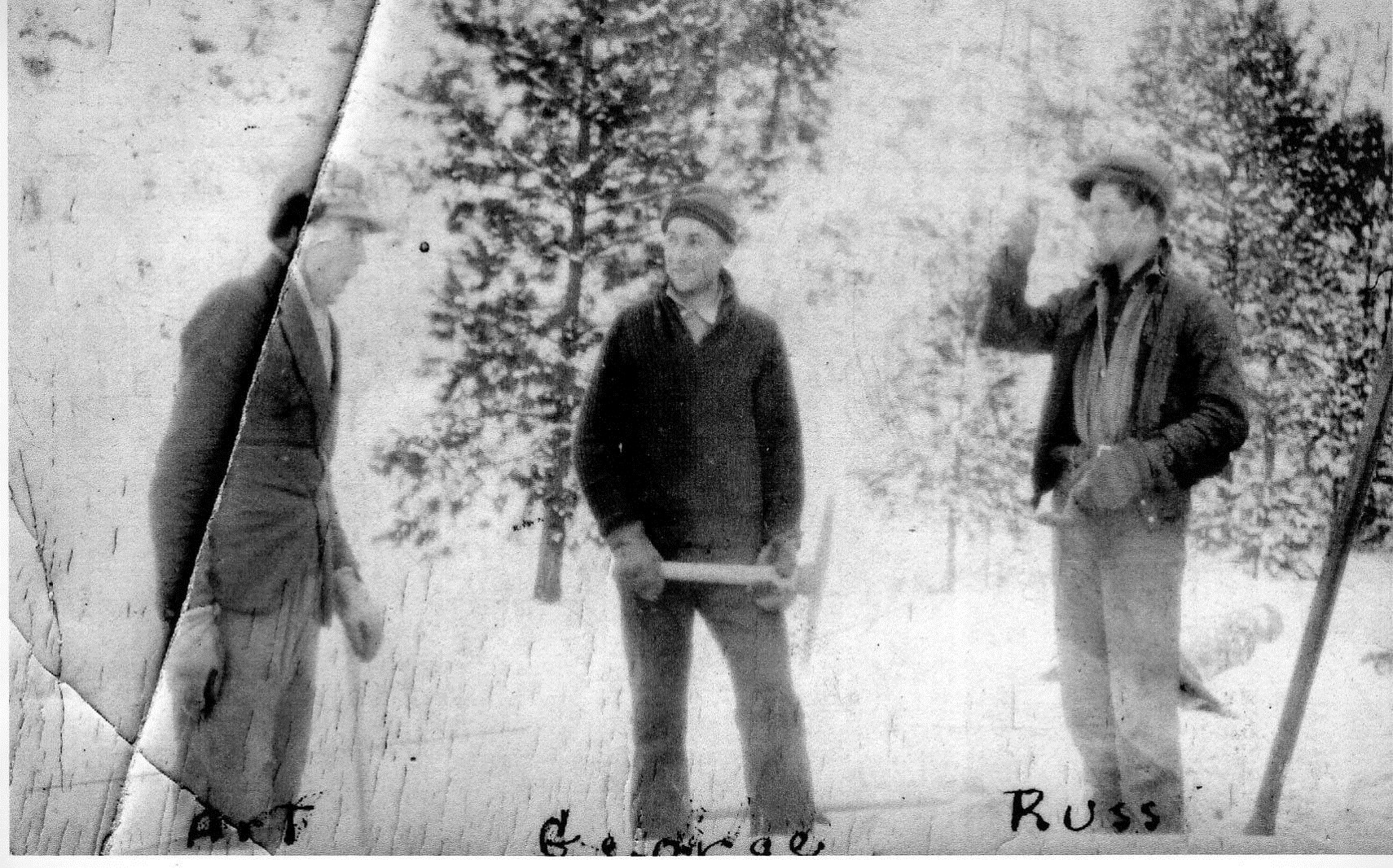
Photo of Art (last name not known, George Bitterman and Russell Shaw
On January 9,1936 the West Kootenay Power Line went-down which resulted in cutting off power to Summerland, Penticton, Kelowna, Oliver, Princeton, Hedley, Keremeos and other points in the Okanagan and Similkameen Valleys. The line collapsed about 5:30 p.m. It has been said that the poles went down like dominoes. When the first pole fell, the rest were pulled down by the weight of the sagging line and the result was a toppled line of wire and poles for seventeen miles.
For those of you who are new to Oliver, it is a quite a story of a group of men who had the “guts” to stick it out and get the job done no matter what the cost. Some of the information came from my father Russell Shaw who was part of the 100 man crew sent up to fix the line and some technical information gleaned from the booklet.
The break itself was about nine miles east of Oliver in the area of Camp McKinney and seventeen and one half miles of high tension wire had to be rebuilt. Unable to hold the weight of the sagging wire, every pole with the exception of one or two had been snapped off at ground level. What remained in the ground was rotten through and through. Dad said some of the poles that rotted were Tamarack..soft wood while those that withstood the break were Cedar.
The break itself was catastrophic but what was to follow made an almost impossible job even more impossible. Almost as soon as work started the South Okanagan area, usually fairly mild in winter suddenly was thrust into winter weather almost unheard of making conditions dangerous for the men on the line. The temperature suddenly dipped below zero Fahrenheit and arctic winds howled around the already freezing men who had signed on to help repair the line.
The terrain where the damage occurred was rugged with many peaks and valleys.
To make things even worse there was about three feet of snow on the ground making movement treacherous and causing problems hauling supplies, digging holes and erecting the new poles to carry the wire. The snow gave the land a flat look but there was always the danger of stepping off into an unmarked hole below the snow and several men suffered broken ankles.
Roads needed to be plowed out with caterpillar tractors and poles had to be hauled over the treacherous icy mountain trails….all manner of equipment needed to be moved to the site. The men found the going rough and tough but those men kept their heads and worked as hard as they could in those conditions and stayed the course.
The arctic weather was so cold that lunches were frozen solid in a matter of minutes; men were treated for frost bite on their hands, face and ears. Several of the crew dropped out but my Dad and his crew stuck it out. Dad remembers that it took days for his clothes to thaw out even in the house and he was grateful that he was still living at home because his mother always had warm clothes for him when he came home…that and a hot bath and some good warm food kept him going back until the job was done.
Even though conditions were terrible, the men found their sense of humour and told jokes to pass the time while others attempted to sing but found their voices frozen by the cold wind! I also remember hearing (I was eavesdropping) that it was downright dangerous if a fella had to take a leak as exposed flesh froze very quickly and the fellas usually crawled down into a snow bank where they were somewhat protected!!
On February 6th the temperature took a sudden drop to 10 below zero and the winds were now blowing at 30 miles an hour. It was decided to send the crews back to Oliver until the wind let up. In the next few days that followed the temperature ranged from five to twelve below and on February 9th saw the worst day of all when the temperature dropped to 20 below zero and the wind was still at 30 miles an hour.
After the 9th of February, the weather steadied at around zero to five below and the men went back to work. The line was not to be completely fixed until the end of February however.
The men of the “Big Break” were hailed as heroes for staying the course and getting the job done. During the time of the “Big Break” the areas affected by it were supplied power from the Shuswap.
Later in 1936 the Oliver News printed a small pamphlet called “Souvenir of the BIG BREAK on the West Kootenay Power Line.” It has poems and some photographs that are now so old they are of no use but one. It is an interesting account of a very difficult time. The poems are pretty funny though! The Oliver News sold this little pamphlet for 25 cents and Dad bought one as a memento of his time on the line. The photos have faded and the cover is a bit ragged but it remains a wonderful little booklet!
From the Big Break “repairing the high tension line through Oliver in the depths of the coldest winter in the Okanagan was one of the most difficult tasks of its kind ever attempted in British Columbia.”