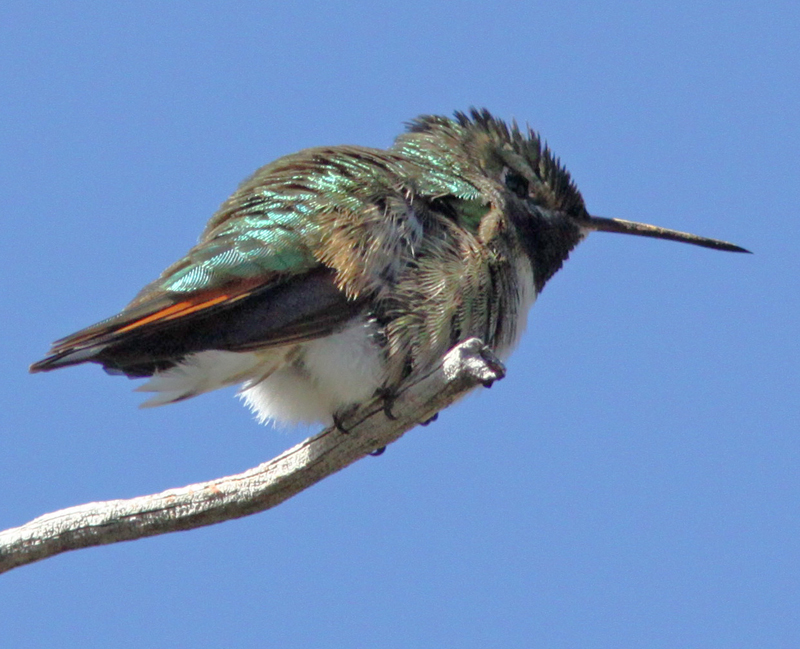
 The Wonderful World of Hummingbirds
In a longer, more general article about birds it is impossible to devote much print to one family of birds. For that reason in a previous article I gave short shrift to one of the most fascinating birding families that we share our spring and summer habitat with; the hummingbirds.
In this article I mentioned that within a month these incredible birds will be amongst us, and, from a migratory point of view, you can almost set your clock to their arrival time. Three of the four hummingbird species that are found here spring through late summer spend the rest of the year in Mexico; ( Rufous, Black-Chinned, and Calliope ). As they feed exclusively on the nectar of flowers, and insects, it is obvious why they leave us after the breeding period. Why they come here in the first place goes back to the concept of abundant food and less competition for this food, combined with our long hours of daylight during spring/summer. The fourth hummingbird species we can see here is the Anna’s. Seeing as they have similar food needs as the other three it is interesting that this bird will overwinter as far north as the coastal parts of SW British Columbia. On the other hand, perhaps it is not surprising, as in the mildest parts of this region there is almost always something in bloom, and when not, it is still warm enough for insets to be flying around.
Many of us put out hummingbird feeders to be able to watch these birds up close as they engage in elaborate courtship behaviors and other acrobatic flight patterns. Their long narrow wings allow them to engage in very agile flight, and the fact that their shoulder and elbow joints are so close to their bodies allows them to tilt, pivot, and very quickly change flight direction. These aspects of their anatomy even allow them to hover and fly backwards.
Sometimes when we see our hummingbirds in poor light, they can look rather dull in colour. However when the sunlight catches their feathers, especially the male hummingbirds’s throat feathers called a gorget, the iridescence nature of these feathers light up like a candle.
As they need to be able to access the nectar chambers of flowers, all hummingbirds have long beaks, longer in fact in proportion to the rest of their bodies than any other bird. Their tongues are even longer and are extended beyond the tip of their beaks when they are probing these same nectar chambers. Grooves on their tongues allow the nectar to remain in place until they can ingest it. For those who have had the chance to travel to more tropical climes in Mexico, Central, and South America, I am sure you have noticed that some hummingbirds even have significantly curved beaks. This is an obvious evolutionary adaptation to year-long flowering plants which have nectar chambers the same shape.
Hummigbirds depend on the sweet nectar to “ fuel “ their very rapid metabolism. This is why we will often see them at our feeders as they come in to “ top up “ their energy reservoirs. At night, especially cool ones, they have the unique ability to slow down their metabolism dramatically. This is what is called a torpor state, and it allows them to conserve energy for the next day’s round of activities. Speaking of feeders, as we take on the responsibility of providing snack stops for hummingbirds, it is important for us to do it the right way so as not to endanger the health of the bird. Primarily this means cleaning your feeders regularly. Many sources site a 4 day protocol.; in other words cleaning out your feeders with boiling water every 4 days, and replacing the sugar mixture at the same time. Warm temps and sugar water provide an ideal habitat for bacteria to grow, and if your feeders become such a breeding ground, you stand a very good chance of harming the bird. Ingesting bacteria from feeders will cause hummingbird tongues to swell to the point that they can no longer feed with dire consequences as the result. People often inquire about the right mixture of water and sugar, which should be just ordinary granulated white sugar. Once again many sources cite a ratio of 4 parts water to one part sugar. This mixture should also be made with boiling water, and then allowed to cool before placing it outdoors. Should you go on holiday, or decide not to feed anymore, you should not feel that you are abandoning your feathered friends. Generally speaking we feed birds for our own pleasure. If the feeder is removed they will find other food sources, as, of course nature intended. Finally in relation to the feeders themselves, just about any purchased feeder will work, as they all come in bright colours, ( mostly red ), to emulate the flowers the birds feed from. The packaged “ hummingbird food “ is basically a waste of money, as you can mix up the nectar more cheaply yourself, and the artificial food dye in the package does nothing to attract the birds to your feeders.
Good birding, and get ready to enjoy the show.
Any birding questions? E-mail me at thormanson@live.com