 To Feed or not to Feed…….
At this time of year when we look outside, and the weather is miserable, occasionally, we may think how “ the critters “ make it through the winter when there doesen’t appear to be a lot of food available. Although I am interested in all of the animals, I tend to focus on the birds, as birdwatching is my passion. For those who have a similar interest, a natural tendency is to think how we can help out, and feeding the birds comes readily to mind. Goodness knows there are lots of places locally to buy bird seed, and all the paraphernalia that goes along with it. It’s probably at this point that we should all take a step back and think about what we are doing. A reasonable question to ask is whether the birds really need our help to make it through the winter, or any other time of year for that matter. The definitive answer is no.
From an evolutionary standpoint, birds, like all the animals that we currently share our world with, have evolved to deal with whatever nature throws at them, and still survive, and thrive in many cases. Some of their adaptive measures are truly amazing. Some birds that overwinter with us for example, during the generally colder night temperatures, and obviously when there is less light to see, enter a state of torpor to conserve energy. They slow their metabolic rate to a fraction of what it is during the day, fluff up their feathers for greater insulation, and withdraw blood from their extremities to their core to maintain a sufficient body temperature to survive. In addition birds that do not migrate eat food that is normally available all year round like seed.
Yes, it is true that not all birds make it through the winter, but without trying to sound indifferent, that is how the species survive and gets stronger. The birds that best adapt pass their genes on to the next generation. Any major negative impacts to bird populations, in general, are totally due to man made interventions, and to the introduction into the environment of species that birds do not deal with particularly effectively, like feral and outdoor cats, but that’s another story with apologies to cat owners, especially to those who let their animals out to roam.
Consequently, the only logical response to why we feed birds is because we like to. We like to because we like to observe their beauty, and watch their behavior. Some species like chickadees for example, can even be trained to eat from our hands, and how cool is that? So if we are going to feed birds are there some general guidelines to follow. Yes.
First of all, don’t feed birds food that is not good for them like bread ( no nutritional value ), and rice, ( swells up in their digestive tract ). Black sunflower seed, available almost everywhere, is the best seed to feed our resident populations. It is rich in oil that the birds can readily use. Suet cakes, ( in the colder months ), are also good, and it will attract additional species that are fun to watch like woodpeckers. It is critical to keep bird feeders clean. There are a number of diseases that can be spread from bird to bird when the feeders are not kept clean. Don’t use bleach.
Just clean off any debris, boil some water and pour it over the feeders. As the weather warms up this process should be repeated every 3 or 4 days, including for our hummingbird feeders in April when they return. A sugary solution is ripe for bacteria to grow, and, if that is the case, hummingbirds that use their long tongues to feed may be infected to the extent that their tongues swell and can no longer feed. Death is the result. Also please do not use the prepackaged hummingbird food. The food dye in the resulting solution has been documented to contribute to male hummingbird infertility.
I’ll talk more about this in the spring. The last major challenge is where to place your feeders. This is where we, as humans, can do more harm than good. As previously mentioned, keep them away from areas that bird killing cats can get to. You may think I am being overly hard on cats, which I appreciate are great pets for many, many people. But, following their natural instincts cats will hunt birds even if they are not hungry. Millions, and yes, I mean millions, of songbirds are killed every year in North America by feral , and outdoor cats. Secondly, either place your feeders very close to your house, or far enough way that you may need to use binoculars to see them well. The reason for this is, once again, many, many, birds are killed through window strikes when they fly away from the feeders. They have probably been frightened by a predator, and their instinct is to flee, with the result they fly into windows as they see the natural environment reflected in the glass. The result is often a bird with a broken neck.
By placing your feeders very close to your house, the birds don’t have enough of a chance to build up speed to kill themselves, and by placing them further away, they have a chance to realize they are flying into a window and take evasive action. There are advertized window treatment solutions to prevent this, but , unless you are willing to invest in a mesh screen that goes over your window, at some expense, the other “ solutions “ don’t usually work.
I truly hope that this article does not discourage anyone from feeding birds. By following “ best practice “ you will not harm birds and, in the quiet winter months, watching birds at feeders can provide hours of enjoyment. Although I have personally cut back on bird feeding I still carry on on a reduced basis. In my opinion, any activity that helps us to appreciate the beauty of our natural surroundings, and increases our knowledge can’t be all bad.
As usual, if you have questions related to birds in the beautiful South Okanagan, one of the premier birding destinations in Canada, do not hesitate to ask.
thormanson@live.com.
Good birding
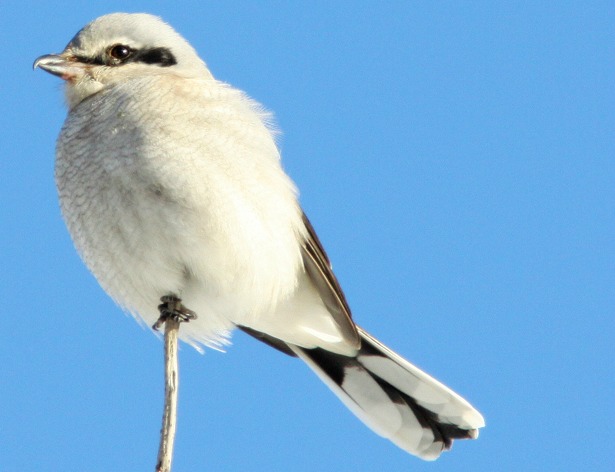
What is the bird pictured?