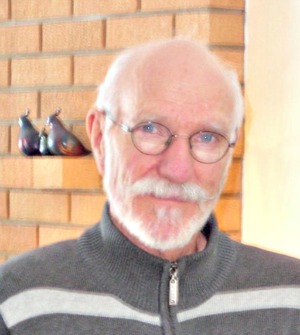
With Remembrance Day just around the corner, I too have a story to tell.
My father, Wally Smith was of age to go to war but couldn’t. When he was ten years old, he was stricken with polio which left him with one leg being shorter than the other which gave him a noticeable limp.
He was fourteen when the First World War started and thirty nine when the Second World War started. He had to stay home and farm while his pals went off on an adventure to fight the Hun.
I don’t take the adventure of war lightly, but photos of smiling troops marching off to battle make war look like a carefree adventure. Perhaps it was their naivety and pride of uniform and country that gave them license to smile while being photographed.
Joining the army had been one of my childhood dreams and I wanted to fulfill it. There was a certain amount of intrigue and mystery surrounding the military and as a boy the army was heroic in my eyes.
At the age of thirty seven, I enlisted in the Canadian Army Militia in Edmonton. At the time, I was thirteen years away from the “old” age of fifty and felt that by the time I got to the age of fifty I would be too old to do anything.
For me, I had to learn some basic truths about volunteering to fight for my country. First, was that my job was to die for my country. Of course nobody really took that seriously because we were young and still felt invincible.
The second truth was the camaraderie was an essential element to the functionality of the military unit. We gained this through suffering together as a group. We learned to flow and move together as one man.
The third truth was a personal struggle. We were being trained with the rifle. I was faced with the fact that the purpose of my rifle was to kill people, that was it’s reason for existence. I struggled with that idea. It didn’t sit right with me.
What could I do to overcome this obstacle? I continued to learn about the firearm, how to take it apart and put it back together again, all done reluctantly while trying to justify the existence of the killing implement.
Then the truth occurred to me. If I didn’t learn how to handle and use the firearm, I would be a danger not only to myself but to my fellow soldier. I then poured myself into my work and learned all I could.
Like father like son, I too had a defect that the army didn’t want, so they gave me my walking papers. Since that disappointment, I’ve learned from reading and watching documentaries that war is not a pleasant adventure.
That brings us back to November 11, the day chosen to exhibit thankfulness to those who fought in the World Wars and the Korean War. For your commitment, your sacrifice, and your suffering, there are no words that adequately describe how grateful we should be.
To put it simply, thank you.
ruralreportwithlairdsmith@gmail.com