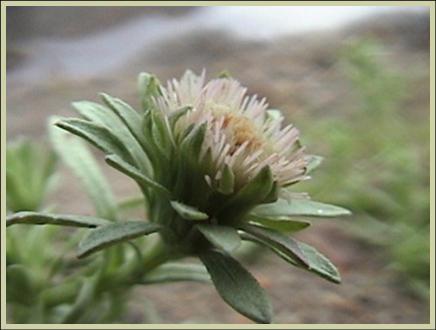
 Scientific Name: Symphyotrichum frondosum
Taxonomy Group: Vascular Plants
Range: British Columbia
SARA Status: Schedule 1, Endangered
Description
The Short-rayed Alkali Aster is a small annual herb, 5 to 60 cm tall, with many branches. It usually grows flat on the ground but can be erect. Its small flowers are clustered in numerous flower heads, and the heads resemble individual flowers. The heads have small green leaves, called bracts, arranged at the base of the head in a receptacle. The centre of the flower head is composed of small yellow flowers, similar to a daisy, and is surrounded by white or pink threadlike flowers. Plants are generally submersed until late summer, with flowering occurring in August and early September, when the water draws down. A similar species, the rayless alkali aster, can be distinguished from the Short-rayed Alkali Aster by its lack of ray petals dividing the heads.
Distribution and Population
The Short-rayed Alkali Aster is known from Mexico, the United States and Canada. In the United States, it is found in California, Arizona, New Mexico, Nevada, Colorado, Idaho, Montana, Utah, Oregon, Washington and Wyoming. In Canada, it is known only from British Columbia, primarily in the southern Okanagan Valley. The species has been confirmed at four locations: the shores of Osoyoos Lake, the shores of Vaseux Lake, the shores of Skaha Lake and the shores of Max Lake (Penticton).
Habitat
In Canada, the Short-rayed Alkali Aster has been reported primarily from lakeshore habitats in moist drawdown zones of sandy beaches and the perimeters of alkali lakes and ponds in the southern Okanagan Valley, in British Columbia. In these sites, the water draws down in the late summer and early fall, exposing shallowly sloping moist sites suitable for flowering and seed dispersal. As with other beach sites, heavy beach use and beach maintenance at certain sites have no doubt resulted in habitat degradation.