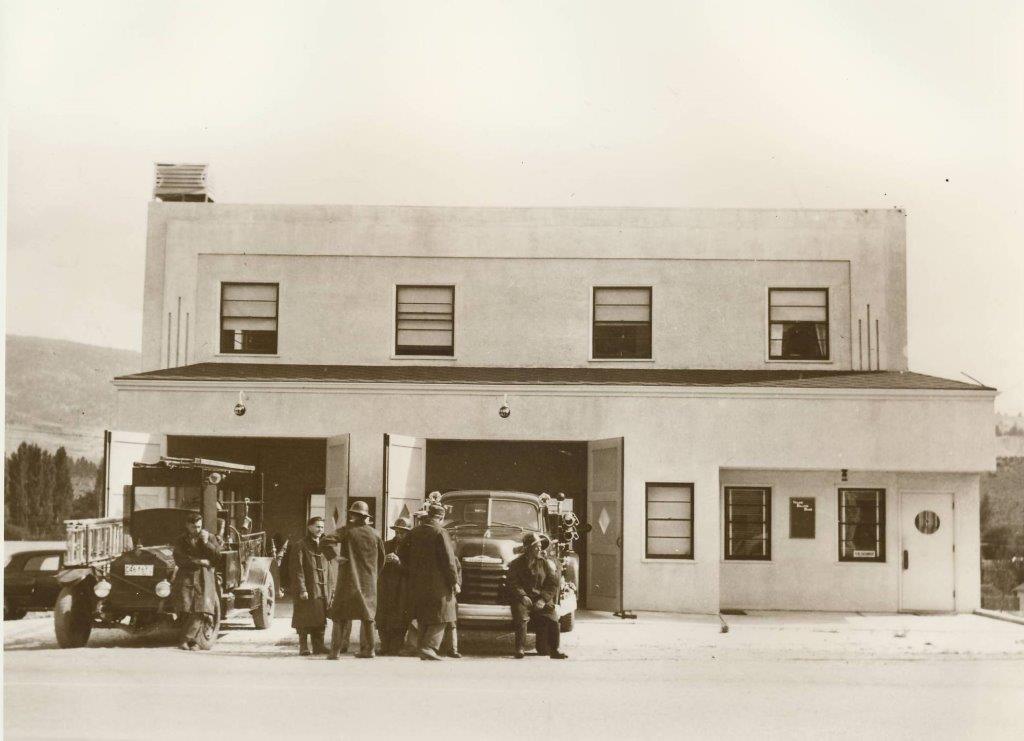
 OLIVER’S FIRE ALARMS
The first siren was a triangle steel bar which hung outside the fire hall and was struck with an iron rod.
The second siren was a hand operated siren which cost $48.00.
The third siren was installed June 14, 1939 on the Griffin building, corner of 1st Avenue and 6th Avenue, now Smugglers Den.
The fire siren switch which was attached to a cord was located on the power pole next to Tuck’s Cafe. This seemed to be a central location, however it caused concern when the local inebriants were looking for excitement would pull the switch causing a false alarm. It would continue to ring until shut off.
After the fire hall was built, the fourth air raid siren installation was made on top of the fire hall building. This gave considerable trouble during the winter months as condensation took place and the fire siren froze. A canopy was placed over the siren but it was not until after the Ogston garage fire that a heater was placed around the fins to prevent freezing. The Ogston fire occurred during the winter that froze so many of the fruit trees that night, the siren on the LaFrance truck had to be used to call the men.
It was so cold that night that the spray from the hoses froze as it fell on us and we were all encased in ice. When the crust of ice got too heavy to carry we shuffled off to Tuc’s cafe to thaw out and have a ration of coffee and rum. By 4 a.m. Tuc’s cafe was almost a lake from our clothing drips.
After the Ogston fire a different arrangement was made. The telephone office had operators on duty 24 hours per day. In those days if a person was on your line you could put your own call through, otherwise you gave central the number and she connected to the proper party.
The B.C. Telephone graciously agreed to allow the switch to be installed in the office. The telephone operators played an important part in receiving emergency calls and dispatching the call to the fire department, doctors, the hospital, the police, etc. They were unsung heroines. The switch still had to be manually shut off.
This system was an excellent one and all went well until someone shimmied up the pole at Tuc’s Cafe and set off the alarm. No one knew where the fire was and it did cause some concern. After that the switch was removed and a switch was placed on the outside of the fire hall.
At that time my wife Joan and I were resident firemen (1951-1955) and to be awakened in the early a.m. to the wailing of the siren was a hair raising experience. It was my job to answer the phone, give her directions, then dress and start the trucks in readiness for take-off. Joan had to open the doors and direct the firemen.
Early in 1951 a relay switch was installed which limited the siren to three minutes in operation. That year we had a bad fire at 2 a.m. on the main street. That fire broke a record, for when I looked up the street, I could see Jerry Joyce and Smokey Hayden running to the hall dressing as they went. Believe it or not we hit the hydrant and had the hose laid before the siren quit. Much to the amazement of experienced firemen, the fire department has always been noted for its fast and efficient arrival at fires. As one chief from the city said “It’s unbelievable how fast your men arrive!”
Like everything else all good things had to come to an end, and around 1955 the telephone company modernized its equipment and we got dial phones. This caused a dilemma, for people called wrong numbers or if looking for information called the fire department and of course the siren went off at the same time. If the caller didn’t stay on the line confusion reigned supreme.
At that time Don and Civy Becker were operating a 24 hour Taxi Service and they came to the rescue when they agreed to set up an answering service which is still being used to this day. In order to accomplish this, lines encased in pipe were placed under the sidewalk to connect the fire hall to their premises. Over the years their service has been excellent, and community is grateful to them.
Booklet recently given to me by the family of Jack Bousfield
Booklet written by Vic Casorso
Picture – date not known
Thanks to Pamela Woolner, Heritage Manager – Oliver and District Heritage Society for scanning the historical document