Last week marked the brewing of our 50th batch of beer here at the Firehall Brewery – a milestone to be sure! We took pictures of each step to show you here on ODN how beer is made at the Firehall Brewery.
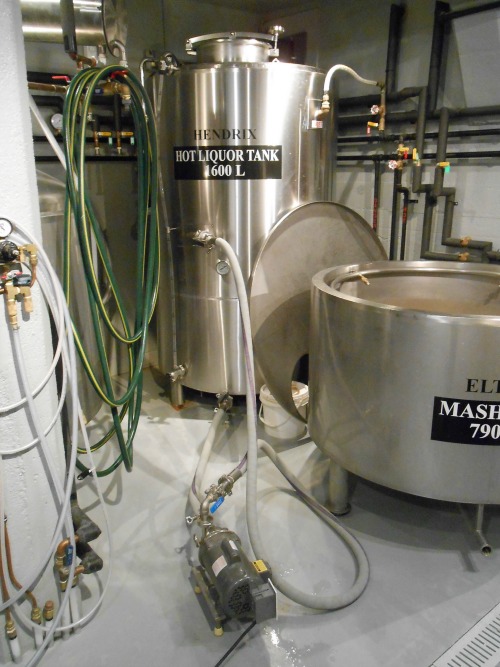
STEP ONE – BOIL the brew water to remove any chlorine that made it through our filters, and to settle out the minerals that add bitterness to the beer. Luckily, Oliver’s water is also rich in other minerals that are very beneficial to brewing, and provides a unique taste of quality naturally. Our water is best suited for darker beers, but great light beers can be made too with proper water treatment. We heat up our water in HENDRIX the Hot Liquor Tank (“liquor” is just the word for water in the brewing industry).
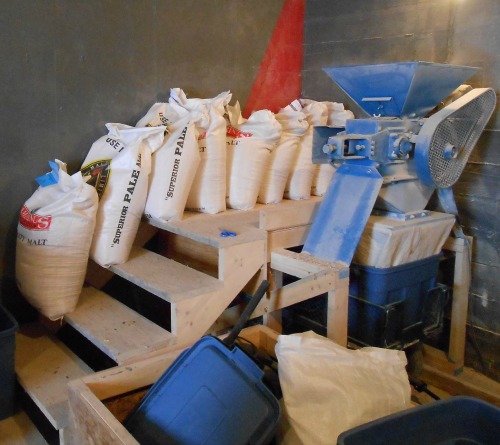 STEP TWO – GRIND up the grain. Meet Bob Marley the Barley Mill. Just like how coffee needs to be ground up before brewing up a pot, the grain (usually barley) has to be milled so it is easier to extract the goodness out of it into water. We use barley from Canada (mainly Gambrinus Malting in Armstrong, BC), USA, England, and Germany. The colour of a beer is mostly determined by how much the barley is heated (by the company that processes it before it heads to the brewery), just like the colour of toast is dependant on how long the slice of bread is in the toaster.
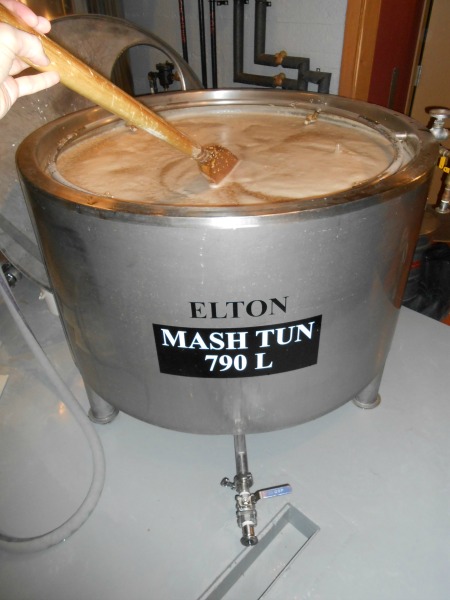 STEP THREE – MASH the hot water with the milled barley in the Mash Tun. Our Mash Tun is named Elton because he can do ales AND lagers – he goes both ways. We must closely monitor and control temperature, pH, and time for the right natural reactions to occur. After sitting for about an hour and a half, most of the barley’s starch has broken down into sugar. Sugar is what will be later converted into alcohol during fermentation. After stirring it up with a canoe paddle (Canadian style!), we separate the liquids (now barley extract) from the solids (leftover grain), transferring the barley extract to the Kettle, and shoveling the leftover grain into bins to be taken to the Southern Plus Feedlot in Oliver to feed the cows (no, there is no alcohol in the grain at this point, so the cows don’t get drunk from it).
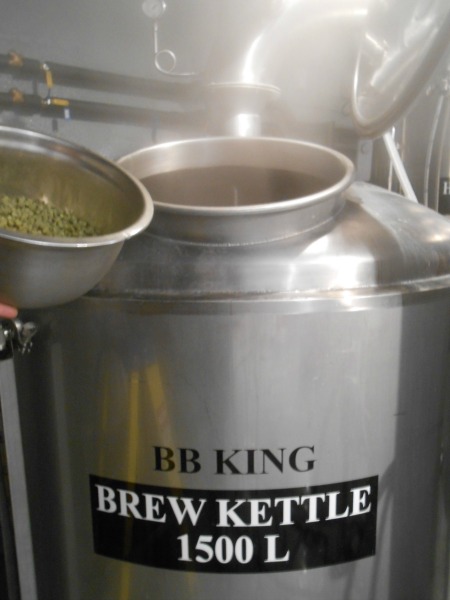 STEP FOUR – BOIL the barley extract in the Kettle for an hour and a half to sterilize it. BB King the Brew Kettle does the job for us, and gets all hopped up when we throw the hops in, adding flavour and bitterness. If beer didn’t have bitter hops added to it, it would be very sweet – too sweet for most people to enjoy. Without hops, the beverage cannot be called “beer”, it is called “malt liquor”. Hops in beer is like pepper on steak. Steak isn’t make of pepper, it’s made of beef, and beer isn’t made of hops, it’s made of barley and water. But pepper has a massive influence on steak flavour, just like hops do in beer.
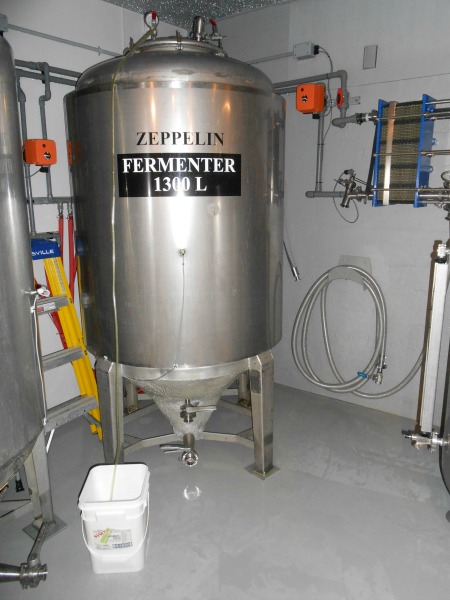 STEP FIVE – FERMENT the barley extract in the Fermentor. We have two Fermentors, Led & Zeppelin. Zeppelin was the available fermentor for our 50th batch. After the boil in BB King the Brew Kettle, we pumped the barley extract through a chilling machine and then straight into the Fermentor. We then add brewer’s yeast, which is a single-cell organism that loves to multiple and eat sugar (just like people!). The yeast eats the sugar from the barley and converts it into alcohol and bubbles.
And there you have it, a Brew Day at the Firehall Brewery. Brew Day is just the first day in a 28-day cycle. For the next week the barley extract will turn into beer as it ferments. After that, we cool it down and transfer it into an Aging Tank in our Cellar for it to age for 3 weeks. Then we carefully tap it off into kegs or bottles under sterile & pressurized conditions, and ship it out to pubs, restaurants & stores “brewery-fresh”. Beer stays “brewery-fresh” for only a few weeks, so to drink fresh beer you need to buy it from a brewery that is nearby. Most of the beer in a liquor store is no longer “brewery-fresh”. So support your local brewer, just like you support your local butcher & baker!
CHEERS!
Story and pictures – Sid Ruhland