Thanks to Sara Bunge (Acting Area Supervisor) BC Parks
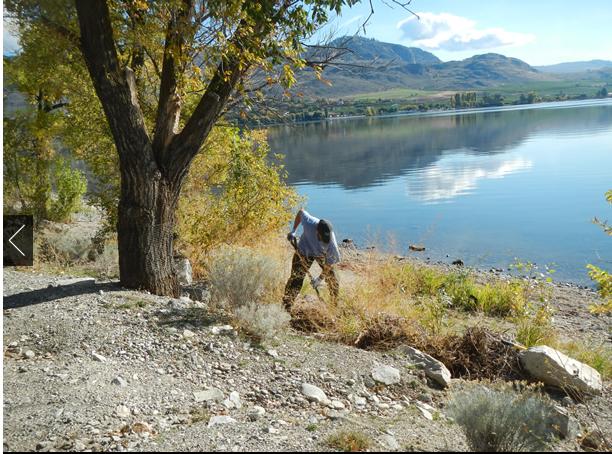
The native ecosystems of Haynes Point Provincial Park are under threat from non-native and invasive species. BC Parks, with assistance from local volunteers, has initiated a restoration project at Haynes Point. This is a multi-year project that aims at shifting the vegetation trajectory (particularly in the western end of the Park) towards more native species. This is accomplished by removing non-natives such as Russian olive, tree of heaven, and Siberian elm, and replacing them with native species like antelope-brush, cottonwood, willow and red-osier dogwood. The estimated duration of the project is 10 to 15 years.
The fall of 2012 saw the removal of most of the Siberian elms from the amphitheatre knoll and planting of approximately 120 antelope-brush with the help of volunteers. These plants were watered throughout the summer and survival rate appears to be almost 50%, which is substantially higher than many other restoration projects involving antelope-brush. We will continue to monitor the antelope-brush.
In early October of 2013, a number of BC Parks staff removed a few more elms from the knoll, as well as a number of Russian olives from the south end of the wetland boardwalk. The limbs were chipped and disposed of offsite. The total amount of material removed was 14 cubic metres of chips! Russian knapweed, baby’s breath, tree of heaven and wild 4 o’clock were also treated in the Park.
Mid-October a number of volunteers joined Parks staff to plant 550 plants on the amphitheater knoll, the wetland trail and along the spit. All the plants were watered once they were in the ground. Some of the species more susceptible to potential beaver impacts were caged off for protection.
Special thanks to our volunteers: Carol Boan, Dan Neiman, Skip King, Kathryn McCourt, Eva Durance and Margaretha Hogeling.
Why are you removing trees from Haynes Point?
Haynes Point has a number of non-native and invasive tree species that threaten rare ecosystems at Haynes Point. The trees of particular concern are tree of heaven, Siberian elm and Russian olive. These species have become well established and dominant in some riparian and upland areas and are out competing native vegetation. In order to shift the trajectory toward native species, we need to remove the competing non-native and invasive trees.Early airphotos show virtually no trees at Haynes Point.
Are you trying to return the park to these conditions?
No. Returning Haynes Point to pre-settlement conditions is not possible nor our objective. Once non-native trees are removed, we will be replanting with native trees and shrubs. Are you going to have any open shoreline to reflect historical conditions? We will not plant in small portions of the lake and wetland shorelines in order to keep them more open. We hope to determine the potential for rare plant recovery in these areas.
How and when are you going to remove the trees?
We have divided the park into 8 treatment units. Each treatment unit will have multiple visits to remove non-native trees and re-plant. This provides for smaller treatment areas, allows for treated areas to regenerate before adjacent areas are treated, and will allow us to adapt our approach as needed. Tree removal and planting will be primarily in the fall. The exception is removal of tree of heaven where the most effective timing of removal is early summer
How is the campground area going to be treated?
Our current plan is to remove only tree of heaven along the point and in the campground. Please note that the hazard tree program is separate from this project and trees may need to be removed or modified for safety purposes at any time of year.
I like to walk the road to the campground. What impact will there be to shade?
Impacts to shade along the road will be minimized by staggering treatment areas. Only tree of heaven is currently being removed along the point, and as a result we do not anticipate significant change in shade along this segment of the road. Treatment of Siberian elm on the road edge in the western portion of the road is not a current priority.
Russian olive provides bird habitat. Will Russian olive be removed and will there be impacts to birds?
The relationship between native bird species and Russian olive is complex. Russian olive fruits provide winter forage for certain native birds; however, research has shown that breeding bird diversity is lower in Russian olive dominated riparian areas compared to native riparian communities. Russian olive suppresses other riparian vegetation that certain bird species use to nest (e.g. yellow warbler in low shrubs), and Russian olive does not provide cavity nesting habitat. In addition, Russian olive is thought to provide little value to the foliage gleaning species. We will be removing Russian olive, but we will be planting native species that will provide cover and forage for wintering birds. There may be a change in winter use; however, we anticipate improved breeding bird habitat over the long term.