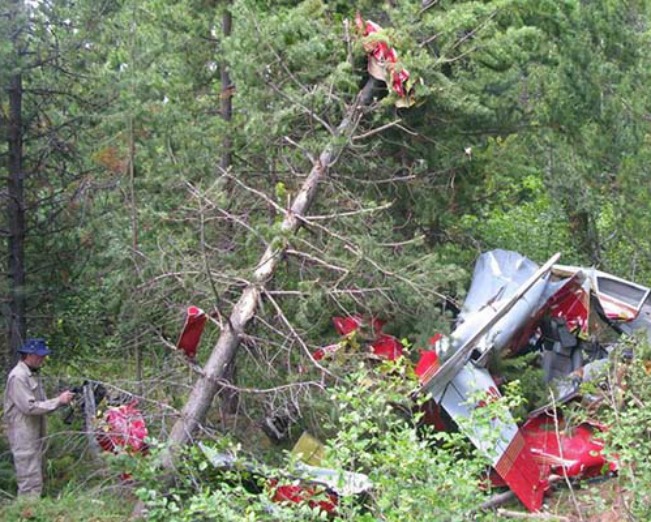
A light plane crash that killed two people and critically injured two others in 2012 was caused by a low climb rate, excess weight and reduced engine power, the Transportation Safety Board of Canada has found.
The TSB said it also determined that lives could likely have been saved if the aircraft had been equipped with shoulder harnesses to complement the available lap belts, which the pilot and three passengers were all wearing.
A shoulder-harness kit was available from and recommended by the aircraft manufacturer but, according to the TSB, the plane’s owners were not aware of this before the crash.
The plane was torn apart in the crash, killing passenger Jayson Dallas Wesley Smith, 30, of Vancouver, instantly. Fellow passenger Lauren Patricia Sewell, 24, of Surrey, died from her injuries two days later.
TSB of Canada Report
Collision with Terrain Piper PA-30 Twin Comanche C-GLGJ Kelowna, British Columbia, 18 nm W 13 August 2012
Summary
The privately operated Piper PA-30 Twin Comanche (serial number 30-300, registration C-GLGJ) departed Penticton Airport, British Columbia, at 1432 Pacific Daylight Time on a visual flight rules flight plan during daylight hours, to Boundary Bay; 1 pilot and 3 passengers were on board. The aircraft flew northbound over Okanagan Lake for approximately 20 nautical miles, before turning west into a valley; this was about 14 nautical miles further than planned, due to a lower-than-expected rate of climb. At 1454, an overflying airliner received an emergency locator transmitter signal, which the airliner pilot relayed to the area control centre, and the area control centre relayed to the Joint Rescue Coordination Centre. The aircraft wreckage was located about 2½ hours later, in a wooded area near the Brenda Mines site, approximately 18 nautical miles west of Kelowna. There was no fire. All 4 occupants were critically injured; 1 occupant died at the site, and a second died in hospital 2 days later
source CBC and TSB