By Lisa Needoba
To see 19-month-old Shae Watson scooting around the community pool deck, you would never believe he has endured eight broken legs and five compressed vertebrae. The local toddler is one of 50 000 people living with Osteogenesis Imperfecta (OI), otherwise known as Brittle Bones.
Toddler Shae Watson, being held by his 8-yr.-old brother Aidan Watson, awaits the 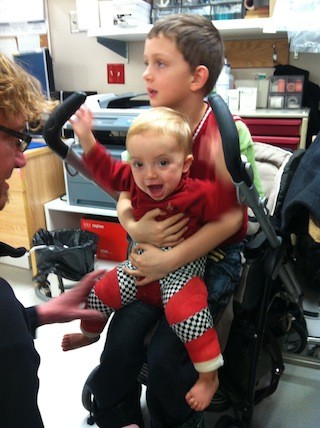 removal of a hip spica cast at PRH after rodding surgery at Montreal Shriner’s three weeks before. The rods were inserted to correct severely bowed femurs due to Osteogenesis Imperfecta or Brittle Bones.OI is a genetic condition affecting the production of collagen in the body. Thanks to cutting edge treatment at Shriner’s Hospital in Montreal, Shae is now climbing, crawling, and most recently, learning to walk, despite his once very fragile bones.
Parents, Mike Watson and Lisa Needoba, received a probable diagnosis while Shae was still in the womb, exhibiting an alarming 27 fractures on ultrasound at 7 months gestation. The family, residents of Kaleden, were asked to relocate temporarily to Vancouver in order to give birth to their third child at BC Women’s and Children’s Hospital in 2011.
Watson said, “Shae was expected to spend his first 2-3 months in the Neonatal Intensive Care Unit, but miraculously was born naturally, full term, with no fractures.” The family was discharged only a few days after Shae’s birth.
But their ‘baby-moon’ was soon over when just a day after returning home to Kaleden, mom heard a crack as she gently sat the seven day old baby up to burp him. “I shook in disbelief, but I knew by his cry that what I had just heard was a bone fracturing”, said Needoba.
At the local emergency department things only got worse when the newborn’s fractured femur became a completely displaced break as the technician positioned him on the x-ray table.
“It was the beginning of a very difficult few months,” said Needoba. Shae would go on to break his other leg two weeks later simply being held by mom to breastfeed. Despite acquiring special handling instructions for IO infants from the OI Foundation, fractures were still unavoidable, and taking the infant to hospital for help was terrifying remembers Needoba.
“We realized very quickly that no one else was going to know how to manage this baby’s breaks well, so we had better learn – quickly.”
The couple used a pillow to carry the newborn for several weeks to cushion his body and limit painful bumping or movement of immobilized fractured limbs. They turned to an on-line support group called OI Parents and soon amassed the splinting materials, pain medication, and training required to splint their baby at home. They met with local pediatrics, emergency and x-ray departments to establish a care plan so that staff would know not to proceed with routine medical procedures that could break a limb.
Since those early days, Shae has been in and out of splints several times, but despite each set back, he just keeps moving forward. “Everyone who knows him is amazed at his happy, easy going demeanour”, Needoba said.
Shae has been traveling to Shriner’s in Montreal, with his mom and a support person, every three months since he was 12 weeks old. He is a research participant in a clinical trial studying the effects of intravenous bisphosphonates on infants with severe OI. “Shae’s bone density has more than doubled in the last year, so we have no doubt that the treatment is helping”, Watson said.
At 15 months of age Shae’s femurs were also surgically straightened and internally reinforced with telescoping Fassier-Duval rods, developed at Shriner’s. “Before the rods, Shae was breaking his femurs just coming down from pulling to stand.” Watson said. “Now he’s starting to walk and we can see that we don’t have to worry about his every move.”
After lots of pool time and physiotherapy with OSNS, the local Child Development Centre, Shae has recently taken his first independent steps, a hard earned milestone for the little toddler.
Thanks to Castanet who published this story earlier this year.
Lisa was one of the speakers tonight at the Oliver Catholic Church at an info meeting for “Highway to Healing” – a new organization to help families with transportation and accommodation when a child needs help at a hospital far away from home.