RE: Crown Land Referrals – Electoral Areas ‘F’, ‘G’ and ‘H’
“Summerland” & “Shinish Creek” Wind Power Projects
Administrative Recommendation:
THAT the RDOS advise FrontCounter BC that the proposed “Summerland Wind Power Project” and “Shinish Creek Wind Power Project” are supported; and,
THAT a new set of General Regulations related to “height exceptions” be prepared for inclusion in Regional District Zoning Bylaws, and that this be brought forward for consideration at a future meeting of the Planning and Development Committee.
Purpose:
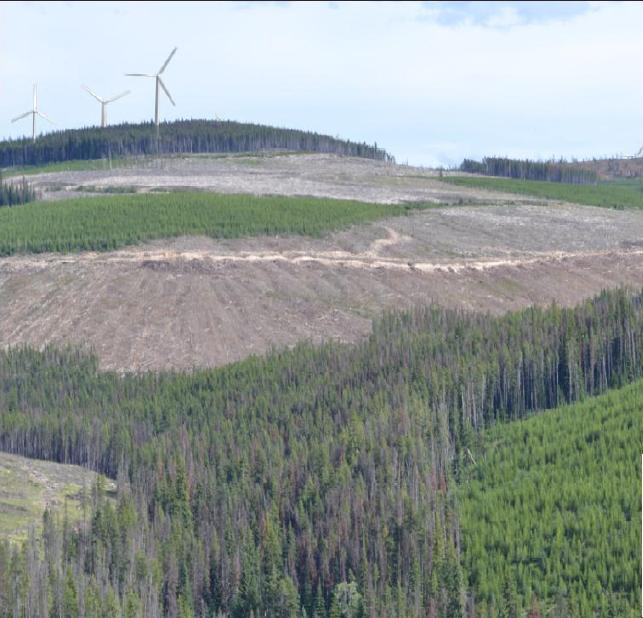
The Regional District has recently received two separate referrals for 14 wind turbines and associated structures, transmission lines and road accesses by Zero Emission Energy Developments (ZED).
These developments are formally known as the “Shinish Creek Wind Power Project”, which involves the development of 7 turbines in Electoral Areas ‘G’ and ‘H’ with an installed capacity of 15 megawatts (MW), and the “Summerland Wind Power Project”, which also involves the development of 7 turbines in Electoral Areas ‘F’, ‘G’ and ‘H’ with an installed capacity of 15 MW.
The applicant is seeking a General Area Licence of Occupation for “Windpower – Development Phase purposes” over an area of approximately 1,009 hectares (Shinish Creek Project) and 390 ha (Summerland Project) for a term of up to ten years.
Referral Requirements:
FrontCounter BC is seeking input:
Does this application impact your agency’s legislated responsibilities?
If the proposal proceeds, will the proponent require approval or a permit from your agency
Is the application area zoned for the proposed purpose?
The area under application is seen to be comprised of un-surveyed Crown land approximately 10 kilometers (km) south-east of Osprey Lake and 32 km west of the District of Summerland. Also included in the Licence of Occupation application is an access corridor via a forestry road from Osprey Lake as well as a transmission line corridor linking to the main BC Hydro transmission line located near the western boundary of Electoral Area ‘H’ (which will cross the Princeton Summerland Road).
Background:
BC Hydro currently offers what it refers to as its Standing Offer Program (SOP), which encourages the development of clean or renewable power projects of no more than 15 MW throughout British Columbia.
The benefits of participating in the program is that the process for small developers selling electricity to BC Hydro is streamlined, contracts are simplified, transaction costs are decreased, and the program supports the principles and policies set out in the BC Energy Plan (2007) and the Clean Energy Act.
Analysis:
The Board is asked to be aware that as a facility intended to provide electrical power into the provincial grid, Administration has received legal advice that the proposed wind power project constitutes a “utility use” under the various RDOS zoning bylaws and, therefore, a use permitted in all zones in all Electoral Areas.
Nevertheless, the proposed development must still comply with any relevant development controls, such as maximum height regulations, and while there is no height restriction in the WRA Zone, the RA Zone limits the height of structures to 8.0 metres.
As the applicant has indicated that “the current wind farm design utilizes seven Vesta V100 wind turbines with a rated capacity of 2.0 MW and hub height of 95m. Each turbine has three blades each at 50 metres in length … [and] the total height of the turbine measure to the tip of the blade is 145m”, a variance for the turbine to be situated within Electoral Area ‘F’ will be required (at that FrontCounter BC be advised accordingly).
This raises an interesting scenario as (BC Hydro) power projects in British Columbia have historically been exempt from local government bylaws, so issues surrounding permitted uses, building envelopes and Development Permit Areas have not traditionally been applied.
That BC Hydro is now requiring independent power producers to be in compliance with local government land use bylaws in order to qualify for consideration under the Standing Offer Program appears to provide the Regional District with a prospective veto over these projects as it is imagined that requiring compliance with the 8.0 metre maximum height restriction would render the proposed wind turbine impracticable.
This issue has also highlighted a potential shortcoming in the Regional District’s various Zoning Bylaws as they relate to structures that typically exceed the maximum height restrictions in a zone, such as antennas, church spires, flagpoles, transmission towers, chimneys and utility poles, and the potential need for Board approval.
Administration notes that both the North Okanagan and Central Okanagan Regional District Zoning Bylaws contain general exemptions for transmission lines and utility poles, as do the Zoning Bylaws of all the member municipalities (i.e. Penticton, Summerland, Osoyoos, Oliver, Princeton and Keremeos). These exemptions, however, do not appear to be applied to wind turbines, likely due to the relative recency of turbines as a feasible source of power generation in British Columbia.
Alternatively, it is also recognised that the introduction of wind turbines in communities elsewhere has, on occasion, been contentious and that concerns associated with the operation of wind turbines (i.e. shadow flicker, noise, visual impact, impact on migratory bird and bat populations, etc.) have been expressed. In response, some local governments have introduced regulations addressing these concerns through siting requirements (i.e. setbacks of four times the tower height from any residence) and maximum noise levels.
In response, Administration considers that there are a number of options available to the Board with regard to wind turbine developments participating in BC Hydro’s Standing Offer Program:
Recommendation
Given the separate provincial approval process and requirements associated with the development of wind turbines, Administration favours reducing duplication between provincial processes and Regional District processes by introducing an exemption for wind turbines in the Resource Area and Watershed Resource Area Zones from maximum height requirements (Option 2 – Sub-Option ‘A’).
For these reasons, the introduction of regulations related to the siting of wind turbines is not favoured at this time, nor is the exclusion of wind turbines from the definition of “utility uses”. Administration considers that the expertise to assess these types of proposals on Crown land properly resides with the relevant provincial ministries.
RDOS document for discussion October 3rd – report has been edited