Keep Zebra and Quagga Mussels out our lakes is a message you are hearing and will hear more about in the future.
These invasive European mussels could easily be transported here from infested areas in the United States or the Great Lakes region of Canada. They were introduced to North America in the late 1980s.
There are no mandatory check point stations in BC, unlike western US states such as Idaho where you cannot launch a boat unless you have been inspected. A new campaign launched this summer will educate recreational boaters about the dangers of invasive mussels and what they can do to prevent their spread.
Zebra and Quagga Mussels are thumbnail sized, freshwater mollusks that rapidly colonize hard surfaces and can clog water-intake structures, impact recreation and devastate local fisheries. In the Okanagan-Similkameen, the effects of their invasion would be felt at the commercial activity level, throughout the tourism sector and at the ecological level. Direct costs and lost revenues are estimated to be in excess of $45 million per year if mussels were to invade Okanagan Lake.
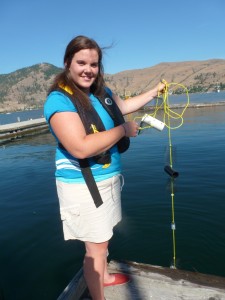 Summer student, Heather Munts, deploying a substrate monitor into Okanagan Lake
Monitoring stations near boat launches in Osoyoos, Skaha, Okanagan and Kalamalka Lakes have now been set up. The vertical stations consist of a series of small sections of PVC pipe and mesh attached to a rope, and are deployed in depths of up to 8-metres. These stations provide an artificial surface for the invasive mussels to attach to. A sensor is also attached to the apparatus to record temperature and light.
“We are highly optimistic that we won’t find anything, however it’s important we monitor to be sure the mussels have not arrived,” said Lisa Scott, coordinator.