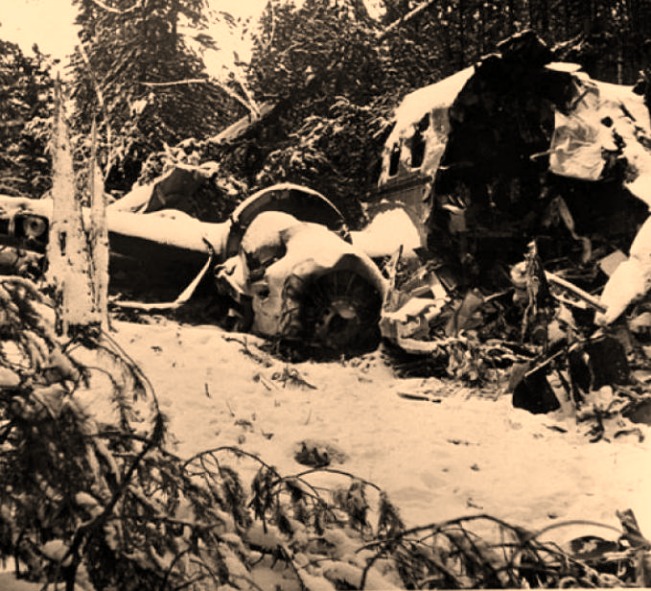
 A CHRISTMAS MIRACLE – The crash of CPA Flight #4 – Brian Wilson
The Douglas DC-3 (CF-CUF) slowly turned right on approach to Penticton Airport. A northern approach is signalled in the cockpit by the illumination of a small light triggered by Penticton airport. At 1:43pm December 22, 1950, the light didn’t go on. At only 4500 feet, the plane skimmed the trees of Okanagan Mountain on the east side of the lake opposite Greata Ranch. Trees began tapping the bottom of the aluminum fuselage as a strange warning of what was to happen seconds later. The engines revved hard in a final futile effort to climb away from the mountain that grabbed at the wings. The belly of the plane smacked the snow, a tree sheared off the cockpit and the fuselage turned 180 degrees, coming to rest very close to a gully incline that would have plunged the wreckage down the mountain. The engines and the tail plane had broken away but the fuel did not erupt in flames.
Pilot Thomas Moore and co-pilot Alex Doucette, both of Vancouver, were severely injured in the cockpit. Pilot Moore died almost instantly while Doucette remained alive although his injuries would be his demise over 30 hours later. The fifteen passengers and the Stewardess, Lorna Franco, were alive. Ms. Franco quickly opened a side door and ushered the passengers to the winter woods away from the plane. Ignited aviation fuel was the greatest fear at the moment, so without any possessions or winter clothing, they all rushed out. A nurse on board, Ora Blackmer, ran to the cockpit and found the co-pilot alive. She and the Stewardess pulled him clear and administered what first-aid they could.
CP Air operations in Vancouver were not concerned with the flight being overdue as it was common in 1950 to calculate a flight’s capacity to overfly or choose a different airfield based on the amount of fuel on board. It was now 2:50pm. Vancouver CP Air operations informed the Department of Transport that they had a late flight. Department of Transport called RCAF 12 Group Rescue that they may be needed. They waited for the estimated fuel usage time to elapse. At 8:50pm, a downed aircraft was announced. A Rescue group took off for the Okanagan. The local RCMP was called and they sprang into action.
Meanwhile, on the ground seven hours after touch down, the passengers salvaged what warm clothing they could, even using curtains from the plane for warmth. Using a hatchet they lit several fires for warmth and signalling. At 10:45pm, an RCAF Dakota, one of seven aircraft in the search spotted the fires on the mountain. As the plane buzzed the mountain, Pilot F/O Glaister radioed Penticton that he had spotted people waving torches. It wasn’t until 3:30am that the first ground party of citizens and RCMP officers headed up Naramata road. The crash site was believed to be somewhere between Paradise Ranch and Squally Point. The group was not prepared for the terrain and the deep snow. It took 16 hours to make it to a cabin at Baker Lake; there they slept then turned back to Penticton, defeated by the fog and terrain. It took almost two days from the time they set out to get back to Penticton.
Meanwhile, at 9:30am that same morning, a Dakota took off from Vancouver with Sgt. Jamison, one of two RCAF para-rescue members prepared to drop into the crash site with medical supplies and rations. They had to move fast as weather was rapidly changing and soon there would be no visibility for a parachute drop. The drop was perfect and within a couple of hundred yards of the survivors.
The Sergeant radioed immediately for a medical drop as co-pilot Doucette was semi-conscious and in great pain. They administered morphine then Jamison and his mate set to work building shelters and enlisted able bodied survivors to feed the rest.
Knowing that the first ground party was lost, the RCMP arrived at the gate of Paradise Ranch, north of Naramata, to enlist the help of the owner, Victor Wilson, then an O/C of the BC Dragoons. Victor knew the mountain very well and had often travelled the old native hunting trails. By 10:00am Dec. 23rd, the second rescue unit left the Armouries in Penticton for the mountain. Wilson had gathered Dr. Stapleton, two of his ranch hands and an RCAF pilot, Mickey Grant to break trail. A larger group would follow at their own pace.
This group was unaware that paratrooper Jamison was on site at this time, or how many were injured. Everyone assumed, rightly so, that time was of the essence in saving the lives of the injured.
The pace set was gruelling, the men were soaked through, and soon exhaustion and leg cramps set in but they persevered. Just as darkness set in, they got an answer to their frequent calls. With extra energy they made the site and found the passengers hysterically jubilant to see them. Dr. Stapleton set to caring for the injured Co-pilot Doucette finding no other injuries other than the odd bruise and a black eye.
The third party arrived some time later and helped recover boxes of supplies dropped earlier. They built up the fires to make everyone as comfortable as possible. Continued on page 6
At 1:30am, Alex Doucette succumbed to his injuries, 33 hours after the crash.
The morning of the 24th, the passengers were led down the trail to be loaded on a bus waiting near the ranch. The ordeal was over, a miracle of survival made possible by Pilot Moore’s last valiant effort to pull up the plane and the landing on three feet of snow.
This tale of heroism can’t be completed without noting the bits of bureaucratic bungling that kept the rescue from happening in a timely manner. Firstly, the RCMP, the RCAF and CP Air launched separate and independent search teams; none of which communicated with each other. The first ground party was not told of logging slash fires burning on the mountain and were told by observers across the lake that the fires were the crash site. When the first ground party requested snowshoes for the return trip, 50 pairs were dropped on the crash site instead. Snow boots were eventually dropped for the survivors for the walk to Paradise Ranch.
The press of the day reported that the rescue had been accomplished by boats on Chute Lake (difficult through three feet of ice); another reported a KVR rescue train had saved the day.
After several months of recovery of valuables, the cockpit, wings and other debris was burned leaving only the fuselage on the mountain. Jack Serwa, a salvager from Kelowna hauled the fuselage out in 1952. He sold what parts he could to a DC-3 salvage firm in the U.S.
Rumour has it that a DC-3 with some of the parts from CF-CUF did a ceremonial flyby of Okanagan Mountain to honour the pilots of CP Flight #4.
sources: OHS annual reports
photo credit: www.oldphotos.ca Okanagan Archives Trust Society